


What's a man-riding crane?
A man-riding crane generally refers to a crane on ships or offshore platforms that is also equipped with personnel-carrying functionality, embodying the advantage of multi-purpose operation with a single machine.
A marine crane is a mechanical device typically used for loading and unloading cargo between ships or between ships and docks/platforms.
However, under certain special working conditions, it is necessary to use cranes to lift and transport personnel. In such cases, it is required to equip the original crane with a dedicated man-riding winch and an independent control system for it – this type of crane is referred to as a man-riding crane, distinguishing it from ordinary cranes.
A man-riding winch consists of a wall frame, drum, man-riding cage, hydraulic motor, reducer, drum brake, and valve group.
A man-riding buffer system is installed in the middle section of the man-riding steel wire rope, which is composed of a buffer cylinder, an accumulator, and pulley blocks.
A rope pressing device is fitted on the man-riding steel wire rope.

Cranes suitable for personnel transfer must obtain certification for personnel lifting, i.e., the certificate issued by the classification society clearly indicates that the crane is suitable for carrying people.
Features
- Manual selection of personnel mode, equipped with a rated capacity indication
- Continuous visual prompts (e.g., warning lights) to indicate that personnel mode is activated
- Combined personnel and cargo transfer, economical and efficient
- Enhanced safety factor of steel wire ropes
- Independent secondary braking
Prevention of free fall in case of power failure
Secondary power supply for load recovery
Emergency stop and lowering capabilities
Equipped with a suspended basket
Hooks with lockable safety latches
Certified for man-riding winch
Optional
- Remote control device
- Auxiliary hook
- Boom tip camera
- Line speed sensor
Ship deck monitoring system
Automatic/manual overload protection
Constant tension
Motion compensation system

Applications
Personnel transfer via man-riding cranes is frequently used in oil and gas exploration and production, offshore renewable energy construction and maintenance, as well as general maritime operations, and its role is particularly prominent in emergencies and unforeseen incidents.
Personnel transfer involves a variety of vessels – ranging from large specialized offshore support vessels to small crew transfer vessels. Any vessel equipped with a man-riding crane can transfer personnel to other vessels or structures. Man-riding cranes can be installed on fixed or floating structures, such as platforms, jack-ups, semi-submersibles, FPSOs, or barges.

What are the rules for a man riding crane?
On floating structures and vessels, stability under varying sea conditions affects the movement of the crane boom tip, which in turn exerts a significant impact on lifting dynamics.
Personnel transfer operations using man-riding cranes are typically restricted to the following conditions:
- Sea state with a significant wave height not exceeding 2 meters
- Wind speed not exceeding 10 meters per second
- Visibility conditions: daytime or equivalent visibility
- The safe working load (SWL) for personnel operations shall not exceed 50% of the SWL specified for the operating condition
- Personnel transfer is strictly prohibited while lifting loads (e.g., cargo)
👉+86 15818704927
👉anne@yfm-crane.com/info@yfm-crane.com
👉https://www.yfm-crane.com/contact-us
Design
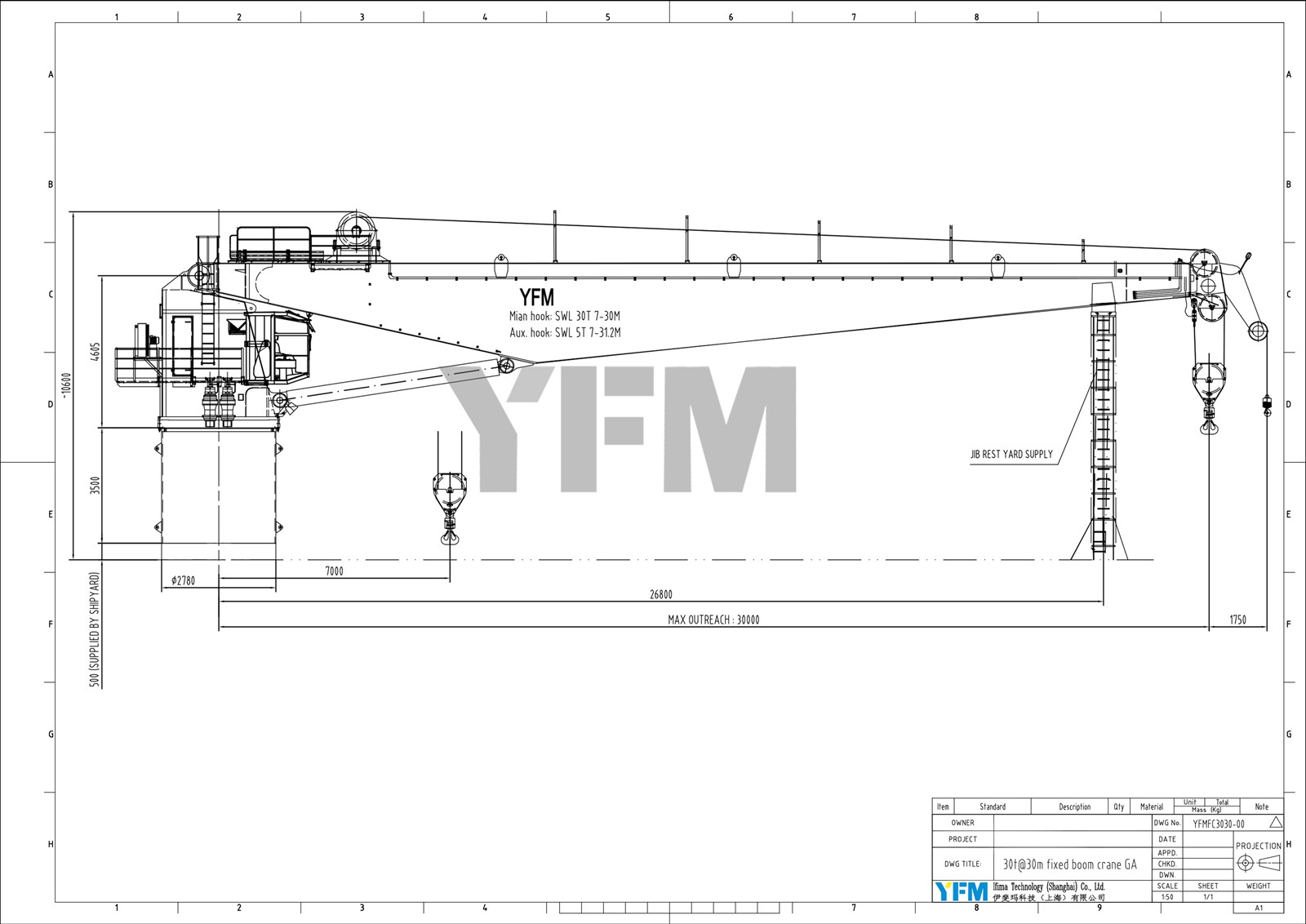

technical parameters
|
Condition |
|
| Working Environment Temp. | 0 ~ +45℃ |
| List/Trim | 5°/2° |
| Working Wind Speed | 20 m/s |
| Non-working Wind Speed | 55 m/s |
| Class | RINA |
| Main Hoist Mechanism | |
| Safe Working Load | 30t |
| Full Load Hoist Speed | 12 m/min |
| Free Load Hoist Speed | 24 m/min |
| Main Hoist Height | 50 m(TBC) |
| AUX. Hoist Mechanism | |
| Safe Working Load | 5t (cargo); 1.5t (man-ride) |
| Hoist Speed | 15 m/min |
| Luffing Mechanism | |
| Luffing Scope | 7 m~30m (main hook) |
| Luffing Time | 100s |
| Slewing Mechanism | |
| Slewing Speed | 0.5 r/min |
| Slewing Angles | 360° no limit |
| Power | |
| Voltgee | 380V/50HZ/3P |
| Power Requirement | 110 Kw |
| Load On Deck | |
| Max. Vertical Force | 1200 kN |
| Max. Overturning moment | 16000 kNm |
| Max. Slewing Torque | 500kNm |
| Crane Weight | ~ 75t |
Hot Tags: man-riding crane, China man-riding crane manufacturers, suppliers, factory, marine telescopic crane, marine crane repair, marine knuckle boom crane, fishing boat crane, marine mobile crane, gantry crane for marine use