


Deck Crane
Deck crane is a device and machinery provided by ships for loading and unloading goods. Mainly including boom devices, rotating devices, and slewing devices. The control of deck cranes is mainly divided into two aspects: vertical control to reduce the impact of ship motion and lateral anti swing to suppress load swing. It is a special type of crane, which can perform transportation operations in the offshore environment. The deck crane has a compact structure, allowing the ship to have more deck area and minimal impact on the bridge’s line of sight. The marine deck crane has simple operation, high loading and unloading efficiency, flexible operation, and no need for tedious pre operation preparation work. The deck crane includes fixed slewing crane, mobile slewing crane, which are commonly used for ship deck crane. There are two types of transmission methods: electric transmission and electric-hydraulic transmission. Different type and capacity,we could customized the deck according to client’s requirements.
-
![Fixed Boom Deck Crane]() Fixed Boom Deck CraneThis fixed boom deck crane adopts an electro-hydraulic drive mode with a rated lifting capacity of 30 tons. Its jib is designed with a box-type structure, featuring stable structure and strong...read more
-
![Marine Telescopic Knuckle Crane]() Marine Telescopic Knuckle CraneThis crane is a marine telescopic knuckle crane, capable of lifting loads up to 3.9T·m, making it ideal for various marine tasks such as lifting maintenance equipment, cargo handling, and...read more
-
![Grab Crane For Bulk Carrier]() Grab Crane For Bulk CarrierGrab Crane Dedicated for Bulk Carriers | Efficient · Intelligent · Weather-resistantread more
YFM grab crane for bulk carriers is a high-efficiency lifting equipment designed specifically for bulk... -
![Transshipment Deck Crane]() Transshipment Deck CraneYFM Transshipment Deck Crane is a heavy‑duty marine crane specially designed for ship‑to‑ship and ship‑to‑shore offshore transshipment. Built with marine‑grade high‑strength steel, C5‑M...read more
-
![Telescopic Boom Deck Cranes]() Telescopic Boom Deck CranesTelescopic boom deck cranes are lifting equipment installed on ship decks, platforms, and similar locations. They feature a telescopic boom structure, typically composed of multiple sections of...read more
-
![Foldable Deck Crane]() Foldable Deck CraneA foldable deck crane is a type of foldable crane installed on the deck of a ship, with a boom that can be folded and stowed. It usually consists of a base unit, a slewing unit, a boom, and...read more
-
![Knuckle Boom Deck Cranes]() Knuckle Boom Deck CranesTailored for ship deck work, this knuckle boom crane uses its unique articulated boom to deliver outstanding flexibility and coverage in limited spaces.read more
It combines strong load capacity... -
![Telescopic Deck Cranes]() Telescopic Deck CranesYour Ultimate Heavy-Lifting Partner on the Waves.read more
Lifting Capacity: 0.5T - 30T+
Max Working Radius:15m - 30m+
Rotation:360° Continuous... -
![Ship Deck Crane]() Ship Deck CraneYFM Ship Deck Cranes are designed for cargo handling, offshore resupply, and emergency operations.read more
The 1-100+ ton precision lifting capacity transforms complex deck logistics into efficient... -
![Vessel Deck Crane]() Vessel Deck CraneYFM Vessel Deck Crane: Your Reliable Marine Lifting Solution for Efficient Cargo Operations.read more
Explosion-proof models (suitable for oil tankers/chemical tankers).
Foldable design (for... -
![Bulk Handling Crane]() Bulk Handling CraneYFM Crane -- Bulk Handling Crane | Revolutionize Efficiency in Bulk Material Operations. Typically equipped with specialized tools like grabs and hoppers, they are used for bulk cargo...read more
-
![Grab Cargo Crane]() Grab Cargo CraneOffshore Hydraulic Crane: Unmatched Reliability for Extreme Marine Operations. An offshore crane with hydraulic power --- offshore lifting equipment. Maximizing Safety & Efficiency.read more


Advantages of Deck Crane
Multi-functional
Despite their smaller size, deck cranes can perform a variety of tasks, effectively replacing multiple pieces of larger equipment on smaller job sites. They are capable of lifting, lowering, and transporting materials, offering a comprehensive solution for diverse job site requirements.
Single Operator
One of the significant advantages of most deck cranes is that they typically require only one operator. This simplicity not only eases the operation but also reduces labor costs and coordination efforts, streamlining the workflow on the job site.
Space Optimization
Their compact design is a standout feature, allowing them to operate efficiently in tight and confined spaces. This makes them particularly beneficial for urban construction sites or areas with limited access, where larger cranes would struggle to perform.
Our factory
Ifima Technology (Shanghai) Co., Ltd.(YFM) was established as an agent subsidiary of Jiangsu YFM group company focuses on expanding oversea market of the crane business. The factory covers an area of 18,000 square meters, with a scientific management team, advanced production equipment, exquisite technology, professional testing and inspecting equipment, as well as completed management system.
Our product
The company's main products are Marine cranes, port cranes, bulk cargo handling grab, and related customized steel structure products.
Our service
There is a skilled sales and R&D team focuses on providing solution-based services pre and after sale to our clients. In order to extend the service life of equipment, Our dedicated team will provide regular maintenance and repair service for your crane , this service is not limited to our products.
Our certificate
As a design and production enterprise of Marine and port equipment , it has been certified by Chinese CCS, American ABS, French BV, Norwegian DNV, British LR, Korean KR, Japanese NK, Russian RS and other classification societies.
Types of Deck Crane
There are several types of deck cranes that are commonly used in marine and offshore industries. These include:
Knuckle boom crane
This type of crane has a hinged boom that can be folded or stretched out for better reach and flexibility. It is commonly used for loading and unloading cargo on ships and offshore platforms.
Davit crane
Davit cranes are used for handling small loads and can be found on small boats, lifeboats, and other marine vessels. They are lightweight and portable, making them ideal for use in confined spaces.
Jib crane
Jib cranes have a horizontal boom that is attached to a vertical mast or support column. They are commonly used in shipyards and ports for lifting heavy items onto and off of ships.
Telescopic boom crane
Telescopic boom cranes have retractable sections that allow for increased reach and lifting capacity. They are commonly used in offshore construction projects and for handling heavy equipment on ships.
Gantry crane
Gantry cranes are large, stationary cranes that are typically used in shipyards and ports for lifting and moving heavy cargo containers. They have a bridge-like structure with legs that straddle the load, providing stability and support.
Lattice boom crane
Lattice boom cranes have a lattice-like structure that provides exceptional strength and stability. They are commonly used in offshore oil and gas platforms for heavy lifting operations.
Each type of deck crane has its own unique features and advantages, making them suitable for different applications in the marine and offshore industries. The selection of the appropriate deck crane for a particular job will depend on factors such as the weight and size of the load, the available space, and the desired reach and lifting capacity.
Applications of Deck Crane
Port operations
Deck cranes are commonly found in ports and terminals for loading and unloading cargo from ships, trucks, and trains. They help in efficiently transferring containers, bulk materials, and other goods between different modes of transportation.
01
Military applications
Deck cranes are used in military settings for loading and unloading vehicles, weapons, and supplies on naval vessels and other military vehicles. They are essential for logistics and maintenance operations in defense and security applications.
02
Offshore oil and gas
Deck cranes are employed on offshore platforms for lifting and transporting heavy equipment, supplies, and personnel to and from the platform. They are crucial for handling drilling equipment, pipes, and other materials necessary for oil and gas extraction operations.
03
Construction industry
Deck cranes are used in the construction sector for lifting and moving heavy building materials, equipment, and prefabricated components on construction sites. They play a vital role in erecting structures, such as high-rise buildings, bridges, and industrial facilities.
04
Shipbuilding and repair
Deck cranes are utilized in shipyards for lifting and positioning heavy equipment, materials, and components during the construction and maintenance of ships. They are essential for loading and unloading cargo, containers, and other items on vessels.
05
A deck crane is more than just a truck with a lifting boom. These machines have specialized components that enable them to transport and lift materials efficiently around job sites. Here are the elements that make deck cranes stand out:
Self-loading carry decks
A defining feature of deck cranes is their self-loading carry decks. Unlike simple transport vehicles, these cranes can load and unload materials onto their decks autonomously. This self-loading capability is crucial for job site efficiency, as it allows the crane to place cargo onto its deck and remove it at different locations without requiring additional equipment or personnel.
Fully hydraulic controls
Deck cranes are equipped with fully hydraulic controls, which provide the operator with precise control over lifting and movement operations. Designed for single-person operation, these hydraulic systems enable pinpoint accuracy in positioning loads. This level of control is essential for safely maneuvering materials in tight or crowded job sites where precision is key.
Outriggers for stability
Outriggers are an essential component of deck cranes, ensuring stability during lifting operations. While rubber wheels offer excellent mobility, they are not sufficient for maintaining balance when the crane is lifting heavy objects. Outriggers extend from the crane to provide a stable base, allowing the machine to handle heavier loads with confidence. This added stability is crucial for maintaining safety and efficiency on the job site.
Load capacity
The load capacity of deck cranes varies by model and specific application. These cranes are designed to handle a wide range of lifting tasks, but it’s important to consult the load charts specific to each model to understand their capacity limits. Generally, deck cranes have a significant lifting capacity, although the transport capacity on the deck may be lower due to the weight resting entirely on the wheels.
Integrated counterweights
Counterweights are built into deck cranes to help to ensure stability and balance during lifting and pivoting operations. Unlike other types of cranes that require manual setup of counterweights, deck cranes have these counterweights integrated into the design. This feature simplifies setup and enhances safety, making the crane more efficient to operate.
Weight and compact design
The weight of a deck crane depends on its size and load capacity. These cranes typically weigh between 3 to 30 tons, depending on the model. Despite their relatively compact size, deck cranes can lift more than cranes of similar weights, thanks to their robust design and integrated counterweights. Their compact design also allows them to maneuver and operate in confined spaces, making them ideal for urban construction sites or areas with limited access. Deck cranes incorporate these specialized components to deliver a versatile, efficient, and reliable lifting solution, making them an invaluable asset for various job site applications.
Major factors to consider
Today, many deck crane options are available in the market. Hence, choosing the perfect one can be daunting and challenging. When picking one, here are some factors you must consider.
Vessel size and type
Vessels come in various sizes and designs, each with unique specifications and requirements. Hence, you must assess the dimensions and weight-bearing capacity of your vessel to determine the appropriate crane size and configuration needed to meet your needs.
Operational environment
Factors such as weather conditions, sea state, and exposure to corrosive elements can impact the performance and longevity of the crane. Therefore, you must choose a crane constructed from durable materials to withstand harsh marine environments and ensure long-term reliability.
Reach and outreach
The reach and outreach of a deck crane determine its ability to access various areas of the vessel and handle loads efficiently. You must consider the layout of your vessel and the specific locations where you’ll require crane operations. Go for a crane with sufficient reach and outreach capabilities to access tight spaces and reach overboard safely and stably.
Lifting capacity
Another primary consideration when choosing a deck crane is its lifting capacity. You must evaluate the maximum weight that the crane needs to lift regularly, including cargo, equipment, and other loads. You should select a crane with a lifting capacity that exceeds your heaviest anticipated load to ensure safety and prevent overloading.
Power source
Deck cranes can be powered by various sources, including hydraulic, electric, or manual operation. Consider the power source that best aligns with your vessel’s infrastructure and operational requirements. Hydraulic cranes are popular for their robust performance and versatility, while electric cranes offer quieter operation and reduced maintenance needs.
Safety features
Safety should always be a top priority when selecting a deck crane for your vessel. Look for cranes equipped with essential safety features. Additionally, ensure that the crane complies with relevant safety standards and regulations to minimise the risk of accidents and injuries during operation.
What to Do During a Deck Crane Inspection?
Daily check marine deck crane
There are operating drivers to carry out daily routine maintenance items, mainly for external cleaning, lubricating rotation work, adjusting and tightening parts, and testing the sensitivity and reliability of the safety device through operation, and whether there is abnormal sound during operation.
Weekly inspection ship cranes
It is jointly completed by the driver and maintenance workers. In addition to the daily inspection items, it mainly inspects the appearance of marine deck cranes, inspects the safety status of hooks, retrieval devices, wire ropes, etc., and the sensitivity and reliability of brakes, clutches, and emergency alarm devices. Observe whether there are abnormal noises and overheating of the transmission parts.
Monthly inspection boat cranes
The maintenance unit of marine lifting equipment and the relevant personnel of the user department jointly carry out the inspection of the power system, hoisting mechanism, slewing mechanism, operating mechanism, and hydraulic system of the marine crane in addition to the weekly inspection, and replacement of wear, deformation, and deformation. For cracked and corroded parts and components, check the reliability of the power feeder, controller, overload protection and safety protection device for the electrical control system. Check the failure symptoms caused by the leakage, pressure, temperature, vibration, noise and other reasons of the lifting machinery through test operation. After observation, perform subjective inspection of the sea crane’s structure, support, and transmission parts, understand and master the technical status of the whole crane, check and determine the source of abnormal phenomena, and after the inspection, it has been determined to record and its operation.

Computer-based cargo spotting systems enable even relatively unskilled operators to cope with the pendulum effects and centrifugal forces. They also help in keeping containers or other cargo units constantly aligned with a given axis, regardless of slewing motion and other external forces. Such electronic aids substantially improve productivity. Some owners report a doubling of the hourly container-handling rate. Other benefits include: reduced operator fatigue, improved safety and lower cargo and ship structure damage.
Cranes have replaced derricks on many modern ships. Generally they are considered as an alternative to the union purchase rig. Deck cranes have a number of advantages, the rigging time being negligible, and the crane is able to pick up and land permitted loads anywhere within its working radius. The safe working loads of cranes is generally of the order of 10 to 15 tonnes and larger cranes are available capable of lifts from 30 to 40 tonnes. As with the union purchase rig the crane is intended for rapid cargo loading and discharging duties with loads which only occasionally exceed, say, 3 tonnes. There is some controversy regarding the merits of cranes as opposed to the union purchase rig, but evidence is available to show that the crane is perhaps less efficient with very light loads.
Cranes may often be positioned on the ship’s centre line, but this may require an extremely long jib when the ship’s beam is large and a reasonable outreach is desired. Transverse positional cranes may then be fitted which, when not under load, can be moved port or starboard and secured to work the hatch and give the desired outreach. Alternatively fixed cranes, one at each end of the hatch, may be placed at opposite corners. This is an arrangement which is useful in discharging to port and starboard simultaneously. There is also a crane which is mounted on a hatch cover section capable of travelling under load along the hatch coaming in the longitudinal direction.
Deck cranes are available from specialist manufacturers and the shipbuilder would be responsible for installation, any local strengthening, and seatings. They are normally positioned between the holds, often on a platform which can be rotated through 360°, provides an immediately operational unit requiring only one man to operate it. Double gearing is a feature of most designs, providing a higher speed at lighter loads. Various types of crane exist for particular duties, for example a general duties crane using a hook and a grabbing crane for use with bulk cargoes.
Three separate drives provide the principal movements: a hoisting motor for lifting the load, a luffing motor for raising or lowering the jib, and a slewing motor for rotating the crane. The operator's cab is designed to provide clear views of all the cargo working area so that the crane operator can function alone. The crane is usually mounted on a pedestal to offer adequate visibility to the operator. For occasional heavy loads arrangements for two cranes to work together, i.e. twinning, can be made with a single operator using a master and slave control system in the two cranes. A common revolving platform will be necessary for this arrangement. The operating medium for deck crane motors may be hydraulic or electric, utilising circuits referred to earlier.
Winches and cranes fitted for lifting cargo on board is required to be of adequate strength and stability for each load, having regard in particular to the stress induced at its mounting or fixing points , securely anchored, adequately ballasted or counterbalanced and supported by outriggers as necessary to ensure its stability when lifting.
The drum end of wire runners or falls should be secured to winch barrels or crane drums by proper clamps or U-bolts. The runner or fall should be long enough to leave at least three turns on the barrel or drum at maximum normal extension. Slack turns of wire or rope on a barrel or drum should be avoided as they are likely to pull out suddenly under load.
When a winch is changed from single to double gear or vice versa, any load should first be released and the clutch should be secured so that it cannot become disengaged when the winch is working. Steam winches should be so maintained that the operator is not exposed to the risk of scalding by leaks of hot water and steam. Before a steam winch is operated, the cylinders and steam pipes should be cleared of water by opening the appropriate drain cocks.
Our factory
Ifima Technology (Shanghai) Co., Ltd.(YFM) was established as an agent subsidiary of Jiangsu YFM group company focuses on expanding oversea market of the crane business. There is a skilled sales and R&D team focuses on providing solution-based services pre and after sale to our clients, The company's main products are Marine cranes, port cranes, bulk cargo handling grab, and related customized steel structure products. The factory covers an area of 18,000 square meters, with a scientific management team, advanced production equipment, exquisite technology, professional testing and inspecting equipment, as well as completed management system. As a design and production enterprise of Marine and port equipment , it has been certified by Chinese CCS, American ABS, French BV, Norwegian DNV, British LR, Korean KR, Japanese NK, Russian RS and other classification societies. "Quality first, Good faith, Be Customer-centric" as the corporate culture, YFM is committed to provide oversea customers with high-quality product and perfect services.


Certificate

Marine Crane CCS Certificate
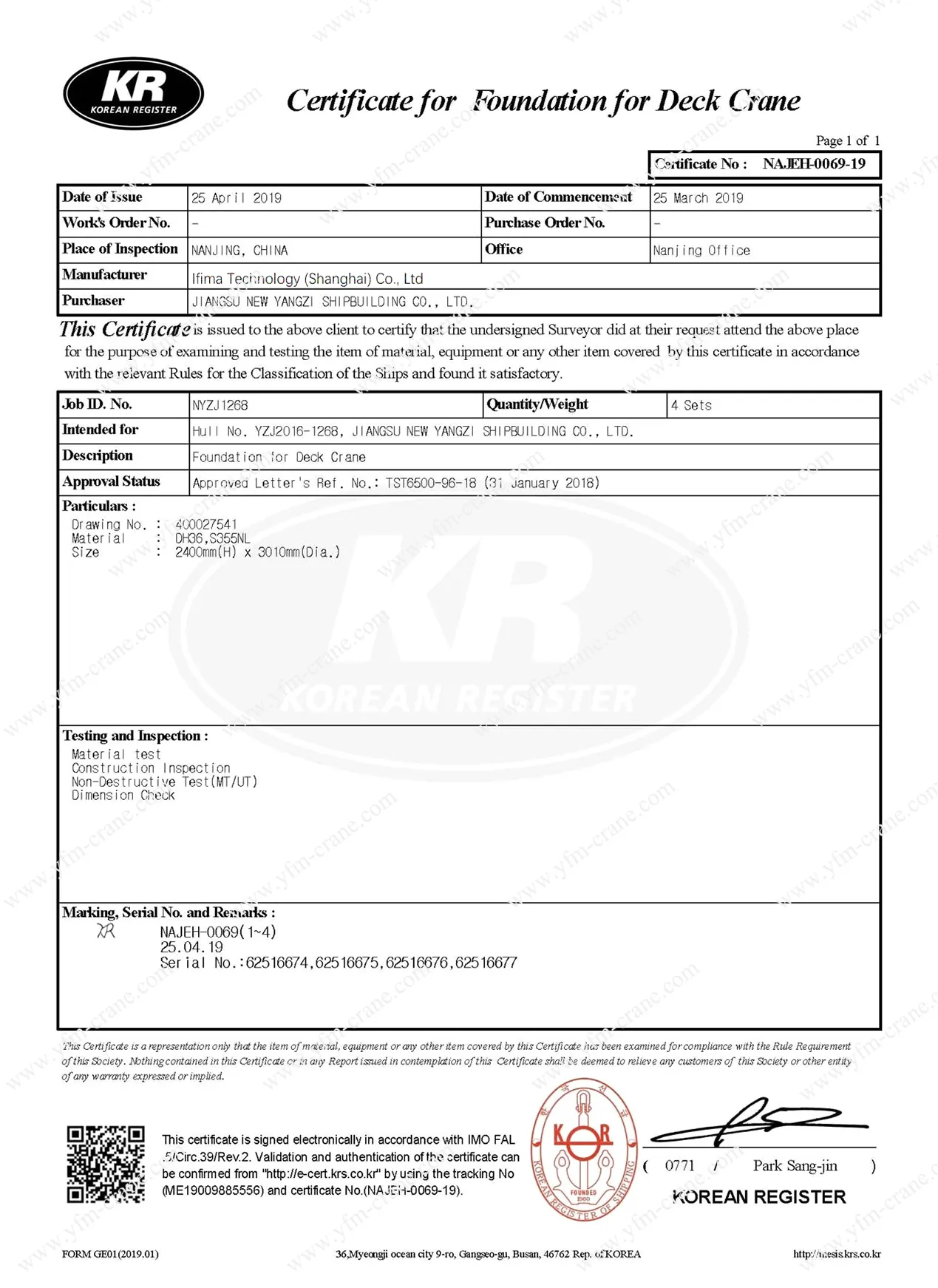
Marine Crane KR Certificate
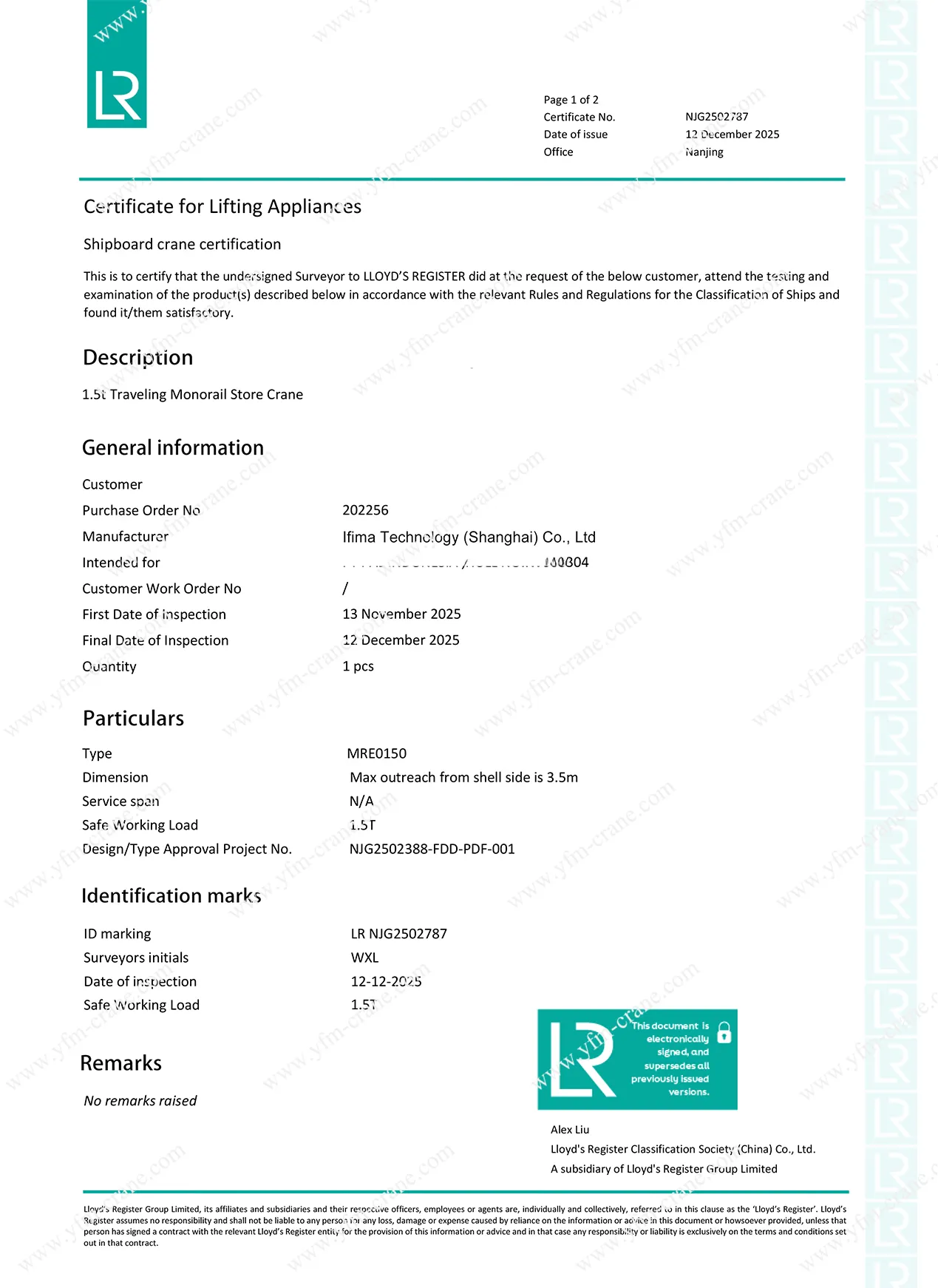
Marine Crane LR Certificate
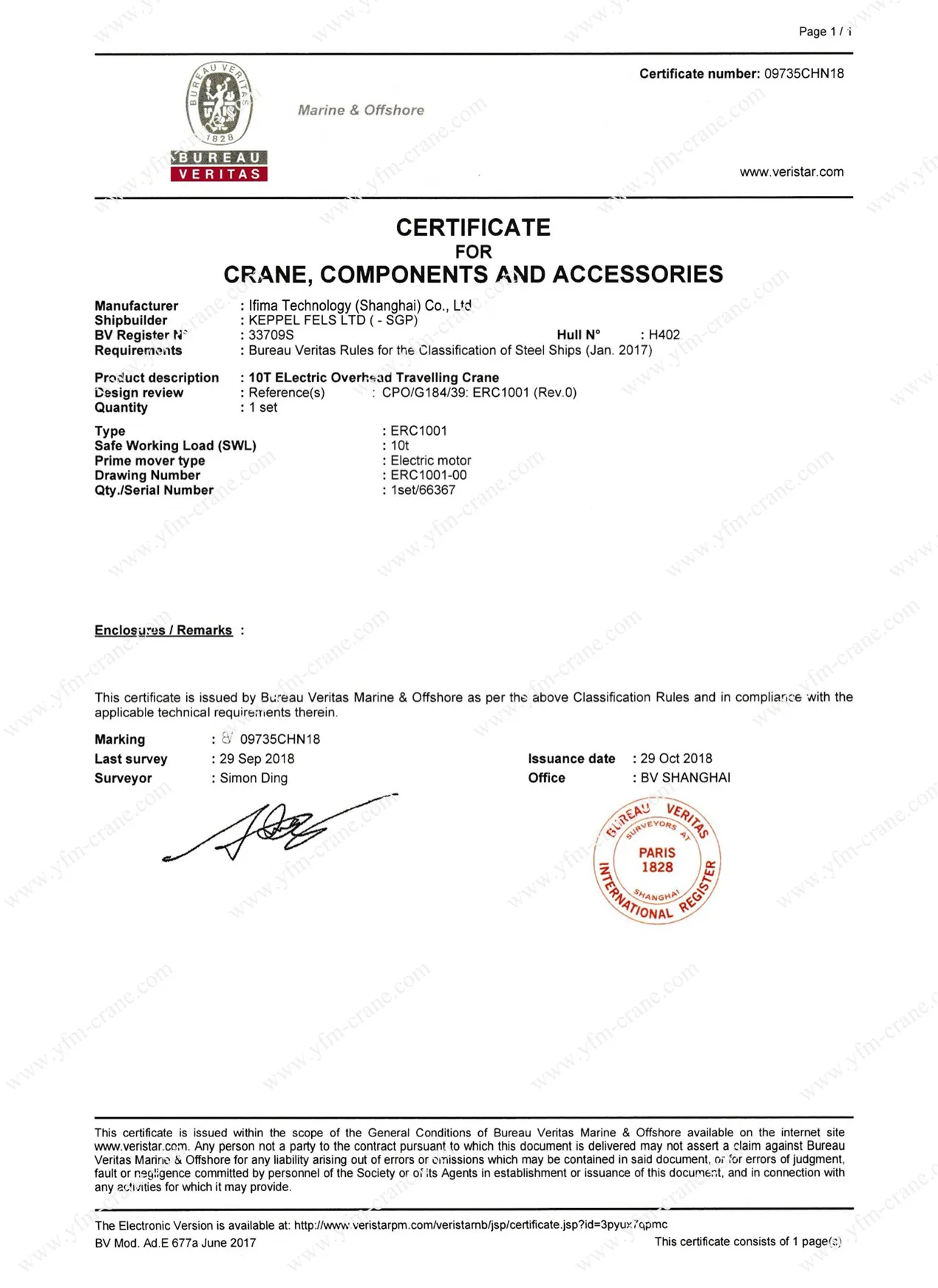
Marine Crane BV Certificate
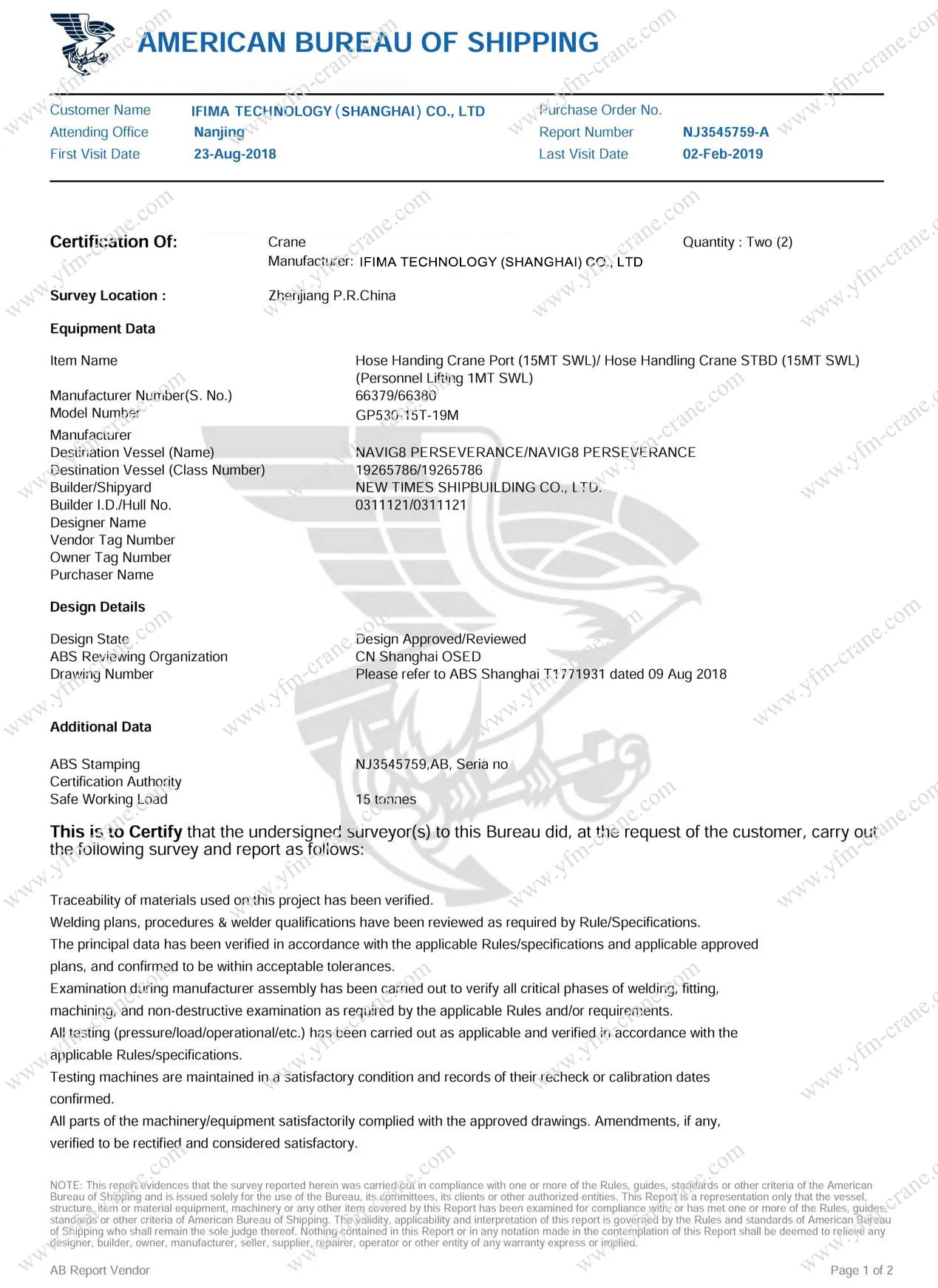
Marine Crane ABS Certificate
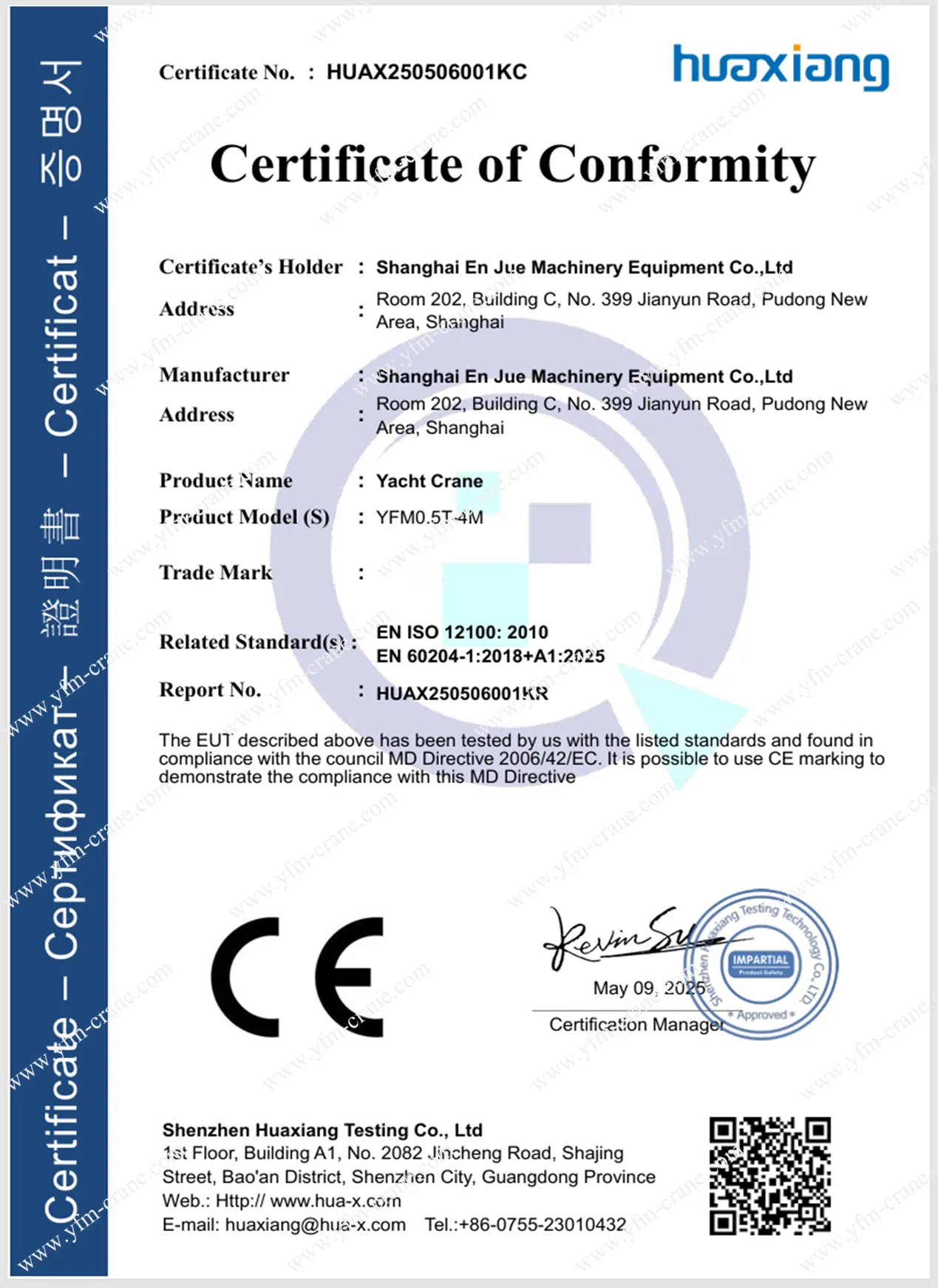
Marine Crane CE Certificate
FAQ
As one of the leading deck crane manufacturers and suppliers in China, we warmly welcome you to buy CE Approved deck crane for sale here from our factory. All customized products are with high quality and low price.
buy deck crane, foldable deck crane, deck crane technical data