


Port Crane
A port crane is a specialised type of crane that is used for loading and unloading cargo at ports. These cranes can be either mobile or stationary, depending on the needs of the port. They are typically equipped with large booms to facilitate lifting heavy loads, as well as multiple cables and winches to ensure stability and precision when handling cargo. Whether operating a large container terminal or a small fishing harbour, having reliable and efficient port cranes is essential for ensuring the safe and efficient movement of goods through the port. With advanced automation systems, these cranes allow for maximum productivity without compromising safety. And thanks to their versatility and flexibility, port cranes can accommodate a wide range of cargo types and sizes, making them an indispensable tool for any port or shipping facility.
-
![Portal Jib Crane]() Portal Jib CraneThe Portal Jib Crane, also commonly referred to as the Shipyard Jib Crane or mobile harbor portal jib crane. It is a harbor lifting equipment that integrates multiple core advantages in one...read more
Portal Jib CraneThe Portal Jib Crane, also commonly referred to as the Shipyard Jib Crane or mobile harbor portal jib crane. It is a harbor lifting equipment that integrates multiple core advantages in one...read more -
![Portal Gantry Crane]() Portal Gantry CraneThe Portal Gantry Crane is a large-scale lifting equipment widely used in ports, stations, yards, and other places for cargo loading, unloading, and handling operations. It can efficiently perform...read more
Portal Gantry CraneThe Portal Gantry Crane is a large-scale lifting equipment widely used in ports, stations, yards, and other places for cargo loading, unloading, and handling operations. It can efficiently perform...read more -
![Dock Crane]() Dock CraneA dock crane, also known as a quay crane, is a large lifting device used to load and unload cargo onto/from ships at docks. It is a key piece of equipment for cargo hoisting. Depending on...read more
Dock CraneA dock crane, also known as a quay crane, is a large lifting device used to load and unload cargo onto/from ships at docks. It is a key piece of equipment for cargo hoisting. Depending on...read more -
![Mobile Harbour Cranes]() Mobile Harbour CranesMobile harbour cranes (also known as mobile port cranes) are key equipment in port cargo handling operations. They feature strong mobility and high lifting capacity, allowing flexible deployment...read more
Mobile Harbour CranesMobile harbour cranes (also known as mobile port cranes) are key equipment in port cargo handling operations. They feature strong mobility and high lifting capacity, allowing flexible deployment...read more -
![Jetty Crane]() Jetty CraneIn ports/docks/jetties and large-scale logistics sites, efficient and safe cargo loading and unloading are crucial. Our box-type stiff boom fixed pedestal jetty crane is specifically designed for...read more
Jetty CraneIn ports/docks/jetties and large-scale logistics sites, efficient and safe cargo loading and unloading are crucial. Our box-type stiff boom fixed pedestal jetty crane is specifically designed for...read more -
![Cargo Handling Cranes]() Cargo Handling CranesPowerhouse Performance: Revolutionize Your Logistics with Cargo Handling Cranes. YFM's cargo handling cranes are the ideal choice for enhancing bulk cargo handling capabilities at port...read more
Cargo Handling CranesPowerhouse Performance: Revolutionize Your Logistics with Cargo Handling Cranes. YFM's cargo handling cranes are the ideal choice for enhancing bulk cargo handling capabilities at port...read more -
![Level Luffing Portal Crane]() Level Luffing Portal CraneYFM Level Luffing Portal Crane can adopt AC variable-frequency speed regulation and PLC control technologies and be equipped with an intelligent "condition monitoring and control system." Its...read more
Level Luffing Portal CraneYFM Level Luffing Portal Crane can adopt AC variable-frequency speed regulation and PLC control technologies and be equipped with an intelligent "condition monitoring and control system." Its...read more -
![Tyre-mounted Container Crane]() Tyre-mounted Container CraneContainer Handling equipment: Efficient, Flexible, an Intelligent Logistics Solution for Ports As the “Transformer” among port handling equipment, YFM Tyre-Mounted Container Crane is a...read more
Tyre-mounted Container CraneContainer Handling equipment: Efficient, Flexible, an Intelligent Logistics Solution for Ports As the “Transformer” among port handling equipment, YFM Tyre-Mounted Container Crane is a...read more -
![Pedestal Port Crane]() Pedestal Port CraneYFM Pedestal Port Crane is a high-performance lifting equipment specially designed for global ports, terminals and logistics hubs. This Pedestal Port Crane, with its modular design, intelligent...read more
Pedestal Port CraneYFM Pedestal Port Crane is a high-performance lifting equipment specially designed for global ports, terminals and logistics hubs. This Pedestal Port Crane, with its modular design, intelligent...read more -
![Mobile Port Crane]() Mobile Port CraneOEM&ODM YFM Mobile Port Crane is specifically designed for ports, logistics hubs, and temporary freight stations. As Port Handling Equipment, the mobile port crane integrates mobility, high...read more
Mobile Port CraneOEM&ODM YFM Mobile Port Crane is specifically designed for ports, logistics hubs, and temporary freight stations. As Port Handling Equipment, the mobile port crane integrates mobility, high...read more -
![Mobile Harbour Crane]() Mobile Harbour CraneOEM&ODM As the “Transformer” among port handling equipment, YFM Mobile Harbour Cranes can easily handle the loading and unloading tasks of various types of cargo, such as containers, bulk...read more
Mobile Harbour CraneOEM&ODM As the “Transformer” among port handling equipment, YFM Mobile Harbour Cranes can easily handle the loading and unloading tasks of various types of cargo, such as containers, bulk...read more -
![Mobile Portal Crane]() Mobile Portal CraneOEM&ODMread more
Mobile Portal CraneOEM&ODMread more
YFM Mobile Portal Crane is a highly efficient loading and unloading equipment specifically designed for modern ports, logistics hubs, and industrial terminals. With its...


Advantages of Port Crane
Improved efficiency and productivity
Port cranes are faster and more efficient compared to traditional methods of loading and unloading cargo.
Increased safety
Port cranes are designed to reduce the risks associated with manual handling of heavy loads, thus ensuring safety.
Cost-effective
Using port cranes can save money resulting from reduced labor costs and increased productivity. Port cranes are a crucial piece of equipment in the shipping industry.
Our factory
Ifima Technology (Shanghai) Co., Ltd.(YFM) was established as an agent subsidiary of Jiangsu YFM group company focuses on expanding oversea market of the crane business. The factory covers an area of 18,000 square meters, with a scientific management team, advanced production equipment, exquisite technology, professional testing and inspecting equipment, as well as completed management system.
Our product
The company's main products are Marine cranes, port cranes, bulk cargo handling grab, and related customized steel structure products.
Our service
There is a skilled sales and R&D team focuses on providing solution-based services pre and after sale to our clients. In order to extend the service life of equipment, Our dedicated team will provide regular maintenance and repair service for your crane , this service is not limited to our products.
Our certificate
As a design and production enterprise of Marine and port equipment , it has been certified by Chinese CCS, American ABS, French BV, Norwegian DNV, British LR, Korean KR, Japanese NK, Russian RS and other classification societies.
Types of Port Cranes
Rubber-tired gantry cranes
A rubber tired gantry craneRTG’s are gantry cranes outfitted with rubber tires for unimpeded movement around the container yard. They primarily move and stack containers throughout the port after the containers have been unloaded from ships or to stage containers in preparation of loading operations. Power is provided typically with a diesel engine, although fully electric versions are becoming common. Power and control to the gantry hoist is primarily routed through cable carriers.
Rail mounted gantry cranes
A rail mounted gantry craneRMG’s are very similar to RTG’s, with the biggest difference being the use of rails for movement rather than free movement with tires. Non-cantilever, single and double cantilever options are all possible. They’re often larger than RTG cranes and require more robust data communication capabilities due to additional onboard equipment and automation functionality. Like an RTG, power and control to the gantry hoist is primarily routed through cable management systems. Typically, RMG’s can handle stacks of three to four containers high and six rows wide.
Automatic stacking cranes
ASC’s are essentially fully automated RMG’s without an operator. They’re both gantry cranes that utilize rail mounted movement and are available in similar sizes. The major difference between the two is that ASC’s are fully automated, improving their efficiency and overall productivity. This makes them ideal for large terminals that require high throughput and stacking density.
Ship-to-shore cranes
STS cranes — Sometimes referred to as quay cranes — are typically the largest of port gantry cranes and are used to load and unload containers from ships the shore or berth. This limits them to being installed along the waterside on rails spanning the length of the berth. There are two main types of ship-to-shore cranes: low profile and high profile. Low profile STS cranes have a non-pivoting telescopic boom that extends out from the crane and over ships, where it’s used to load and unload the vessels. High profile STS cranes have a hinged boom that makes navigation easier for ships during berthing.

A port crane is a large, specialised piece of equipment that is used to move cargo in and out of ports. It consists of several different parts, including the boom, trolley, and hoist.
The boom extends from the main body of the crane and allows it to reach across wide areas. The trolley moves along the length of the boom and transports cargo containers to their desired locations. The hoist is used to lift and move heavy cargo containers around the port.
Port cranes are powered by hydraulic systems, which allow them to operate smoothly and efficiently. They rely on a variety of sensors to help guide their movements, as well as remote controls for operators who are located some distance away from the actual crane itself.
Overall, port cranes are an essential tool in the operations of modern ports. They help move cargo quickly and efficiently, allowing ships to unload their cargo and load new shipments more quickly than ever before. As global trade continues to grow, it is likely that this technology will only become more important and widely used in the years to come.
Port cranes play a vital role in port operations, they have a strong lifting capacity and flexible operating range, can efficiently complete the loading and unloading of various cargo tasks. The following are common application scenarios of port cranes:
1.Container terminal handling
Quayside container crane (quaybridge or quayside crane for short) : This is one of the most common cranes in ports and is specifically used to load and unload containers from large container ships. They are usually installed on the shore of the wharf and have long arms and large spanners that are efficient at lifting containers from the ship and placing them on a collection card or yard gantry crane on the wharf.
Rail or wheeled container gantry cranes (referred to as gantry cranes or gantry cranes) : These cranes are used to stack and move containers on dock yards. They can move on the track or rely on the tires to move themselves, with a large operating range and high stacking capacity.
2.Bulk terminal handling
Grab crane: In the bulk cargo terminal, such as coal, ore, grain and other cargo loading and unloading, grab crane is commonly used equipment. They are equipped with a grab bucket to grab and transport bulk cargo, with efficient and flexible characteristics.
Bucket-wheel stacker reclaimer: This is a large bulk cargo handling equipment, mainly used in large bulk storage yard storage and reclaimer operations. It can continuously and efficiently complete the tasks of bulk storage and pick-up.
3.Cargo terminal handling
Floating cranes (such as floating cranes) : In terminals where large cargo or heavy equipment needs to be handled, floating cranes are favored for their flexibility and powerful lifting capacity. They can be moved to the desired location and are ideal for loading and unloading tasks in deep water or complex waters.
Marine crane: A crane mounted on a ship for the loading and unloading of its own cargo or for the transfer of cargo between the ship and other ships.
4.Ro-ro dock loading and unloading
Ro-ro cranes: In ro-ro terminals, such as car ro-ro terminals, ro-ro cranes are used to lift vehicles from ro-ro ships to the docks or vice versa. These cranes usually have special spares and devices to suit the lifting needs of the vehicle.
5.Special cargo handling
Special cranes: For some special goods, such as dangerous goods, ultra-long and ultra-wide goods, the port will be equipped with special cranes for loading and unloading operations. These cranes usually have special construction and functions to ensure a safe and efficient loading and unloading process.
Parts of Port Cranes You Should Know About
Main boom
This is the part of the port crane that hangs over the ship. The main boom has a hinge above the quay to be lifted, giving space for the ship to move as it needs to. If the crane is smaller and used near airports, where visibility is critical, low-profile booms work best because you can pull them toward the crane when not in use.
Supporting frame of port cranes
This is the structure that holds the boom and the spreader. It is significant, and when on the jetty and performing transverse movements, the frame can be on rubber wheels or rail mounted. The boogie wheelsets are under the crane’s legs, and you can expect the crane to have eight wheels per corner.
Spreader
The spreader is attached to the rail structure and the operator’s cabin. It can also move transversely on the boom when lifting cargo, and it is connected to the trolley with cables. This is the part of the crane that lifts the containers. Depending on the number of containers, it can open and close as needed. Some of them can lift up to four containers at the same time.
Trolley
This is the part that supports the spreader and the operator’s cabin. Finally, a trolley supports the mechanism that lets it ride over the boom while also supporting the hoisting mechanism.
Legs
The crane’s legs generate its height. The more modern cranes have higher legs since the stacking of containers has risen. So you can expect up to eleven containers stacked one on top of the other above decks; the crane has to accommodate that height. The waterside leg, or ws, is thicker than the landside leg, or ls. This is because the ws has to withstand more moment forces.
Power supply and cable reel
A port crane usually has two kinds of power supplies: The diesel generator powered by an engine and rests at the top of the crane and the electric power from the dock and the terminal facilities. Cables create the electrical connection, and they lay in large gutters over the quay. When the crane moves, the motorized reel rolls them on or off.
A Quick Guide to Maintaining Port Cranes
A few simple maintenance principles are the key to avoiding disastrous issues. Combined, they ensure that problems are identified and resolved before they pose a severe threat. Read on for three simple steps to ensure proper port crane maintenance.
Custom maintenance schedules
Port crane manufacturers will likely provide their clients with suggested maintenance schedules. These will cover which parts need to be replaced and when. Responsible companies do their best to abide by these suggestions. But they are only provided as a general guide. Each port crane uses various cargo loads at changeable frequencies differently. Therefore, a one-size-fits-all approach to maintenance routines isn’t the safest approach. Evaluate your maintenance guidelines and what usage amounts they are designed for. Then, customize each crane’s maintenance schedule to whether it gets used more or less than the standard amount.
Take a preventative approach
Once you have devised tailor-made port crane maintenance schedules, monitor the results. When maintenance workers check on parts, are they on their last legs? For example, are brakes wearing too thin, or is grease running too dry? This indicates that the maintenance schedule needs to be more frequent. In addition, maintenance schedules should operate with a preventative goal in mind. That is, maintenance should take place often enough that problems don’t even begin to develop. Invest in keeping ahead of your maintenance needs. That way, you do everything possible to avoid unexpected expenses – and insurance claims.
Work with a reliable parts provider
When a maintenance team identifies an issue, how quickly can they resolve it? That depends on who you choose to partner with. To deliver the best service, the best port crane parts providers specialize in one or two areas, such as port crane brakes and accessories. They also deliver parts to their clients as quickly as possible. As a result, they provide the best quality parts and ensure you experience minimal downtime.

Advances in Port Crane Technology
Port crane technology is continuously evolving, with manufacturers introducing innovations to improve functionality and efficiency. One recent development is the use of automation and robotics. Automated cranes are not only more efficient but also address safety and workforce shortages. Remote operations are also becoming more prevalent, with operators controlling cranes from a remote location off-site. These advances are not only improving operational efficiency but also reducing the environmental impact of port cranes, with manufacturers incorporating eco-friendly technologies such as regenerative braking and hybrid power sources.
Port cranes are the workhorses of our ports, facilitating the smooth and efficient movement of goods across the globe. Understanding the principles, types, and maintenance of port cranes is essential for ports and harbor operations. With advances in technology, port crane operators can look forward to increased efficiency and sustainability. Whether you're a seasoned port operator or just starting in the industry, mastering the port crane will unlock new opportunities and take your operations to the next level.
Our factory
Ifima Technology (Shanghai) Co., Ltd.(YFM) was established as an agent subsidiary of Jiangsu YFM group company focuses on expanding oversea market of the crane business. There is a skilled sales and R&D team focuses on providing solution-based services pre and after sale to our clients, The company's main products are Marine cranes, port cranes, bulk cargo handling grab, and related customized steel structure products. The factory covers an area of 18,000 square meters, with a scientific management team, advanced production equipment, exquisite technology, professional testing and inspecting equipment, as well as completed management system. As a design and production enterprise of Marine and port equipment , it has been certified by Chinese CCS, American ABS, French BV, Norwegian DNV, British LR, Korean KR, Japanese NK, Russian RS and other classification societies. "Quality first, Good faith, Be Customer-centric" as the corporate culture, YFM is committed to provide oversea customers with high-quality product and perfect services.


Certificate
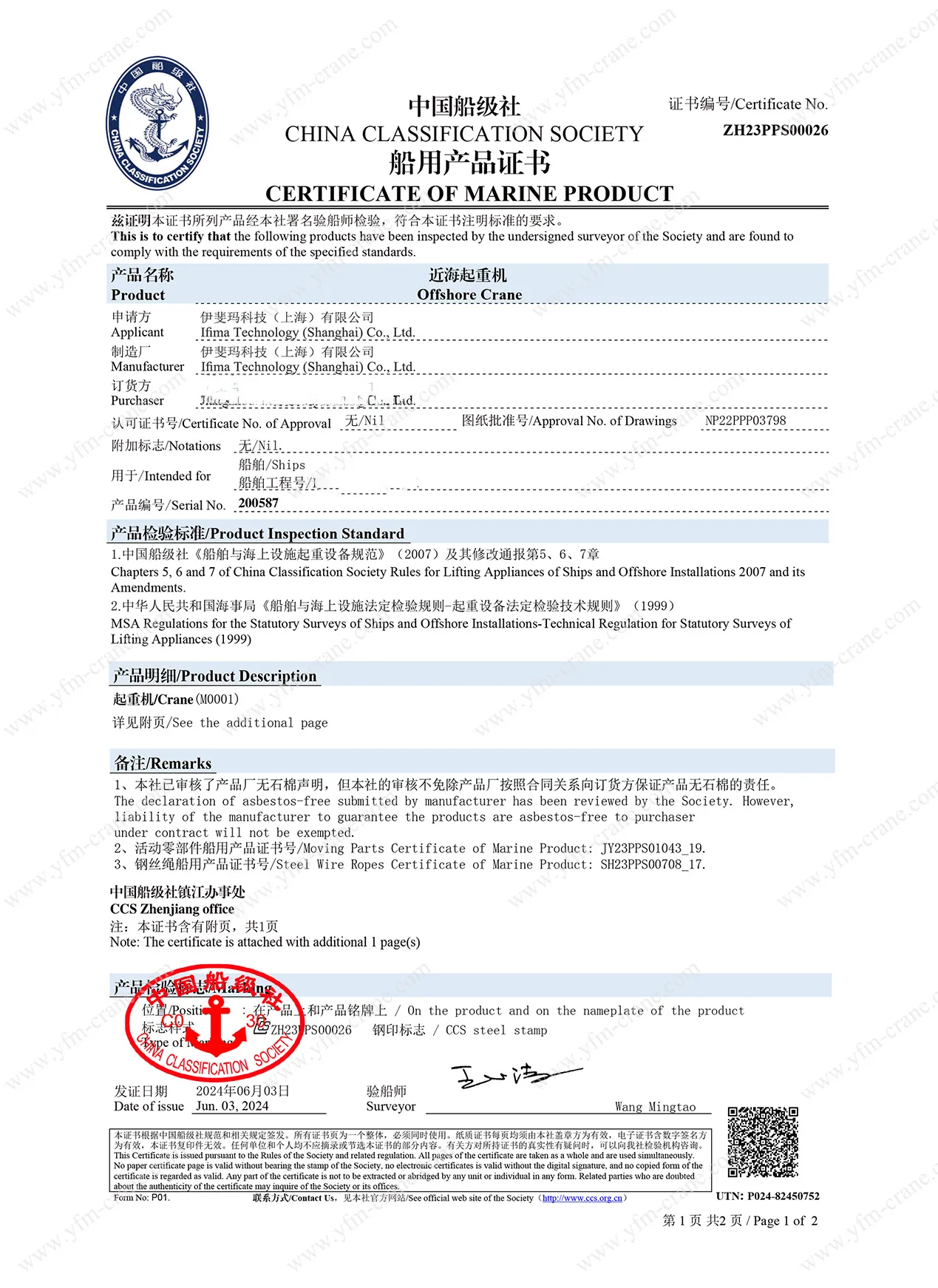
Marine Crane CCS Certificate
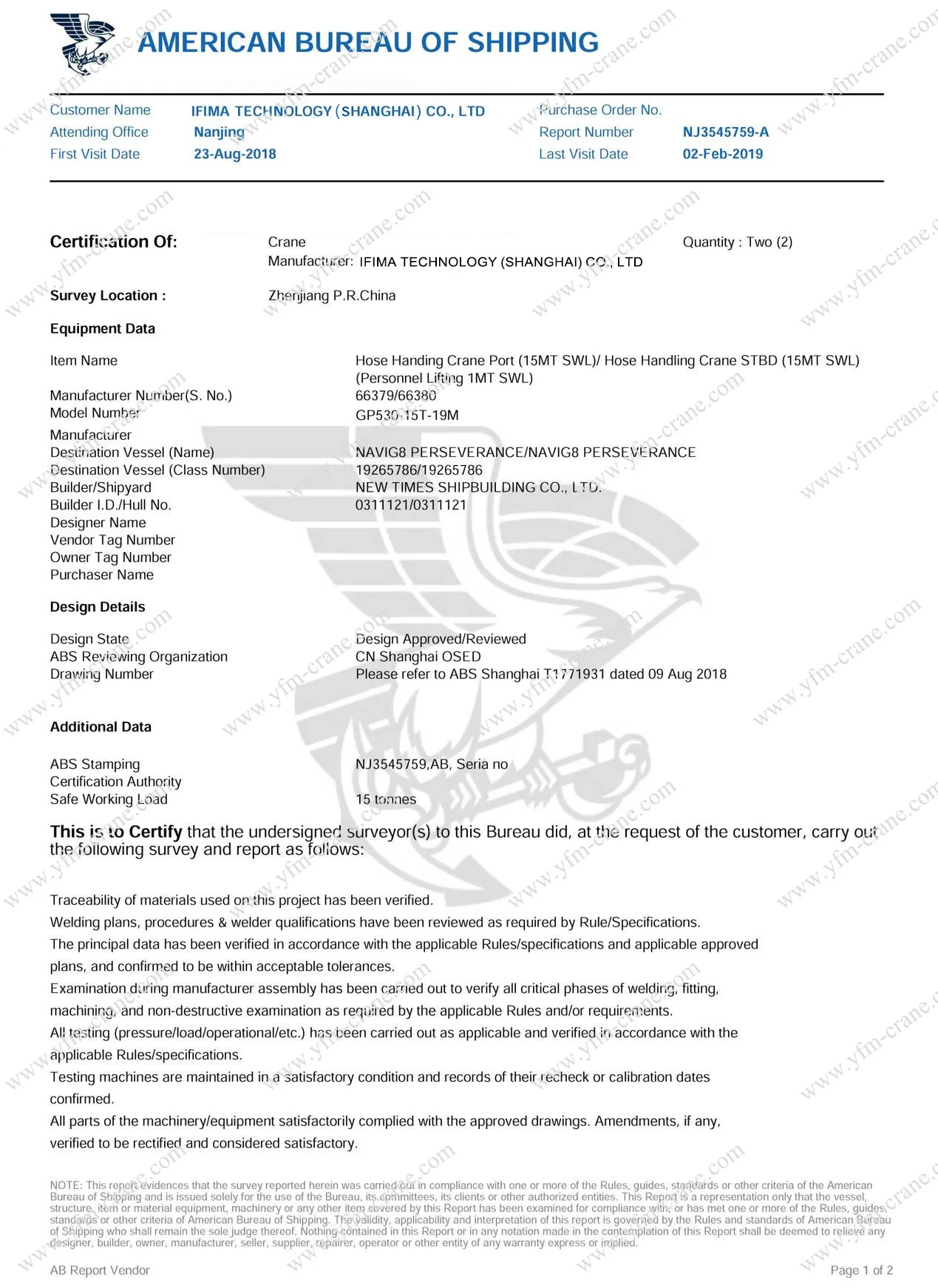
Marine Crane ABS Certificate
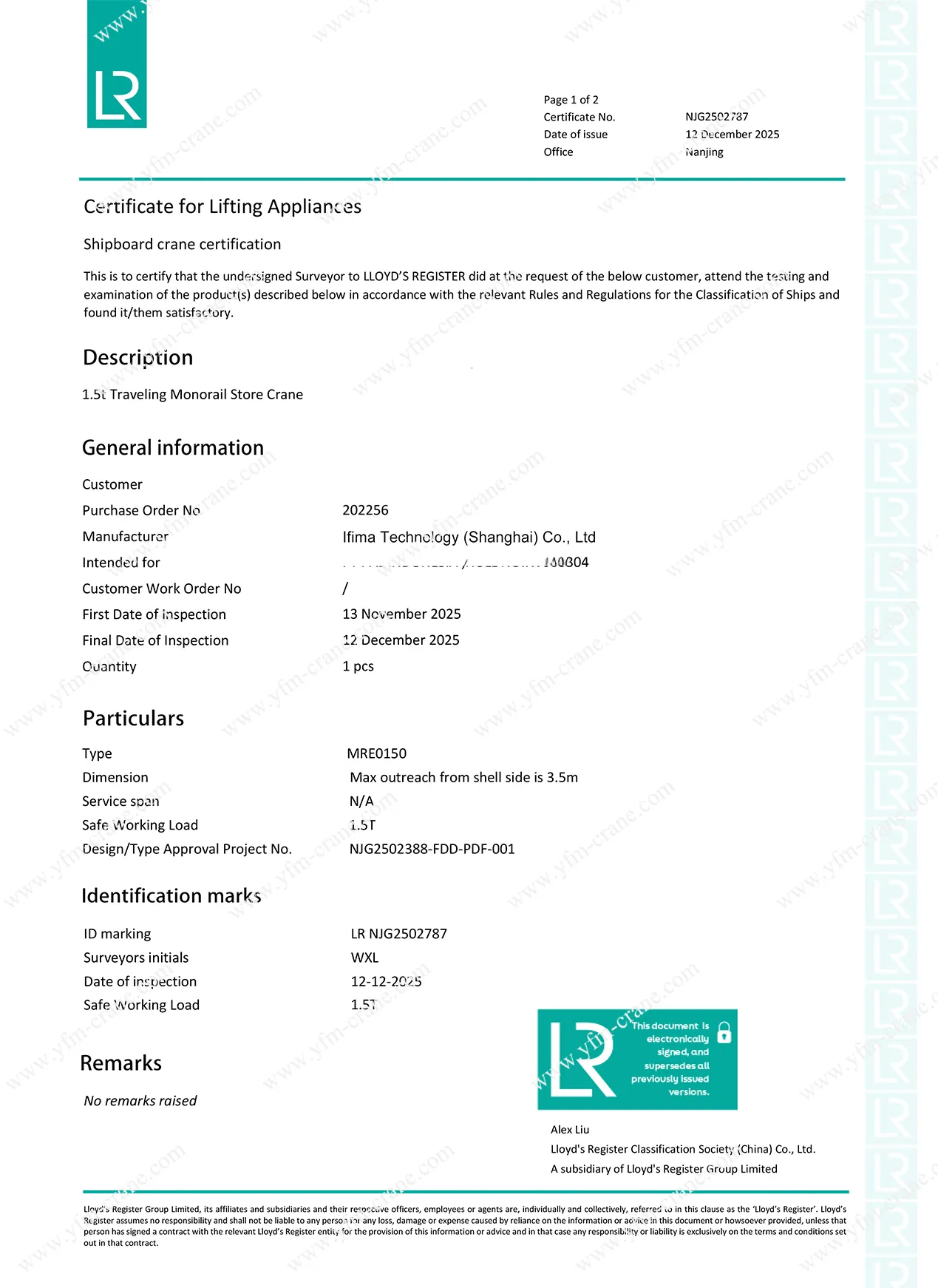
Marine Crane LR Certificate
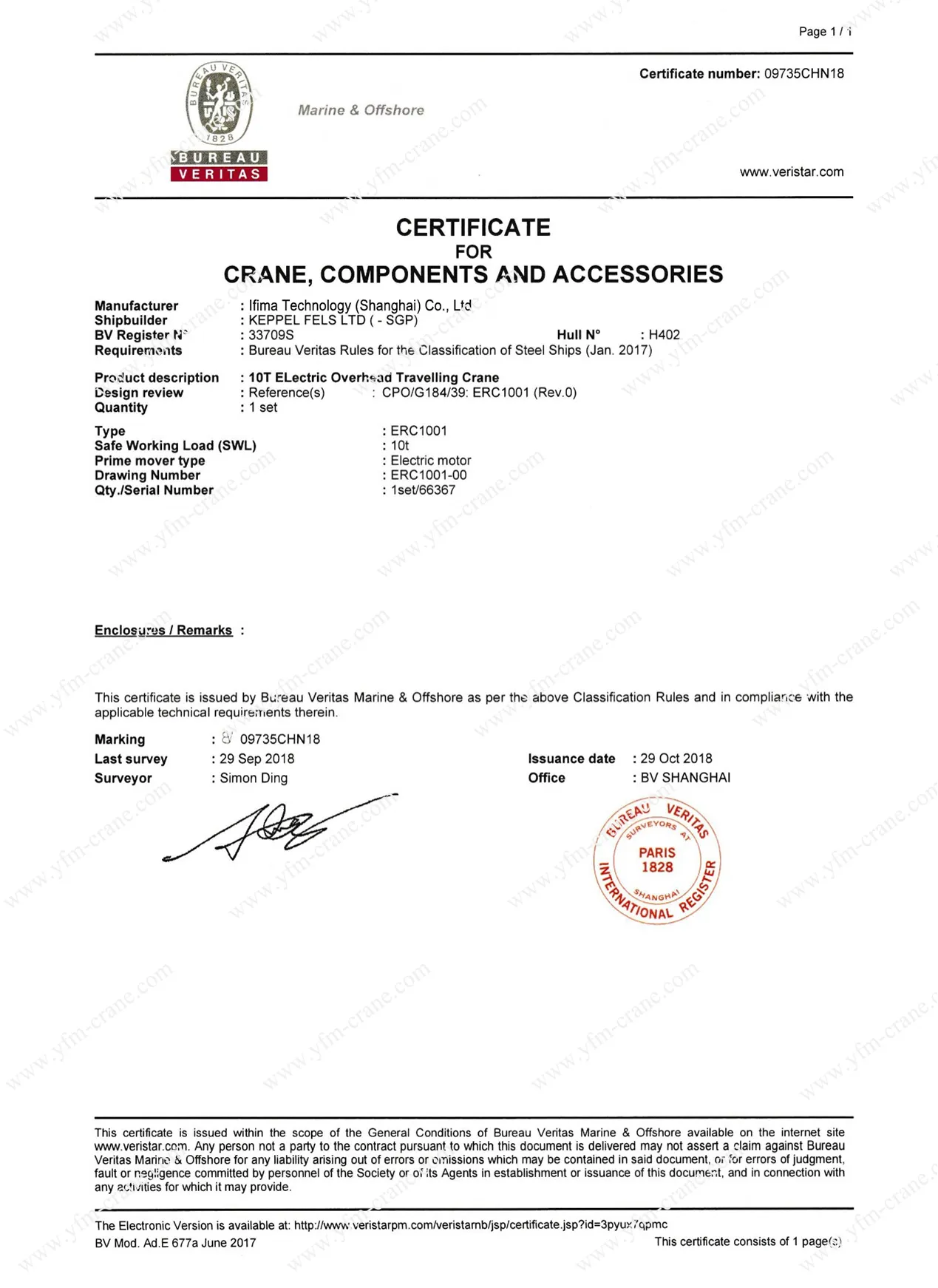
Marine Crane LR Certificate
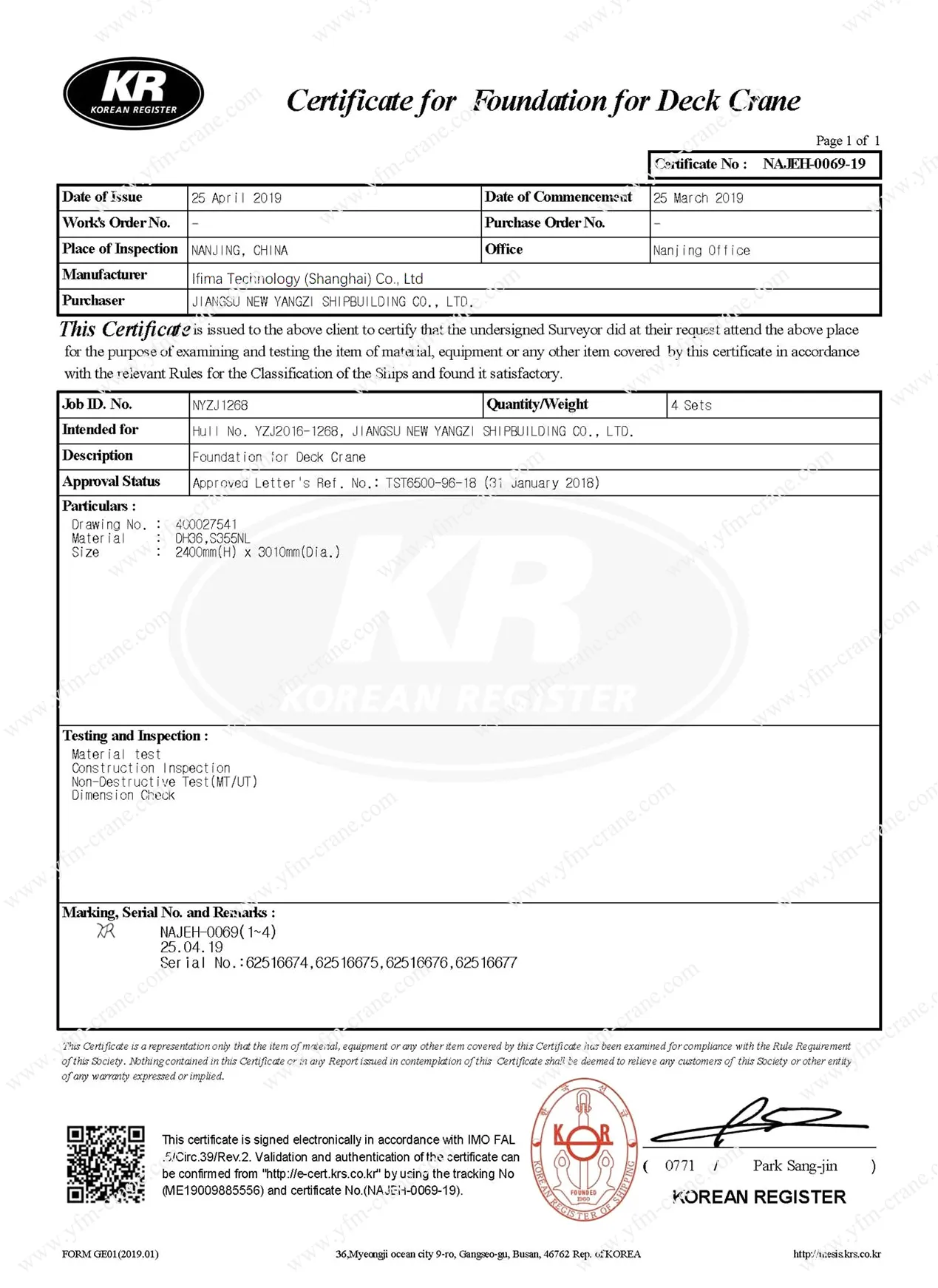
Marine Crane KR Certificate
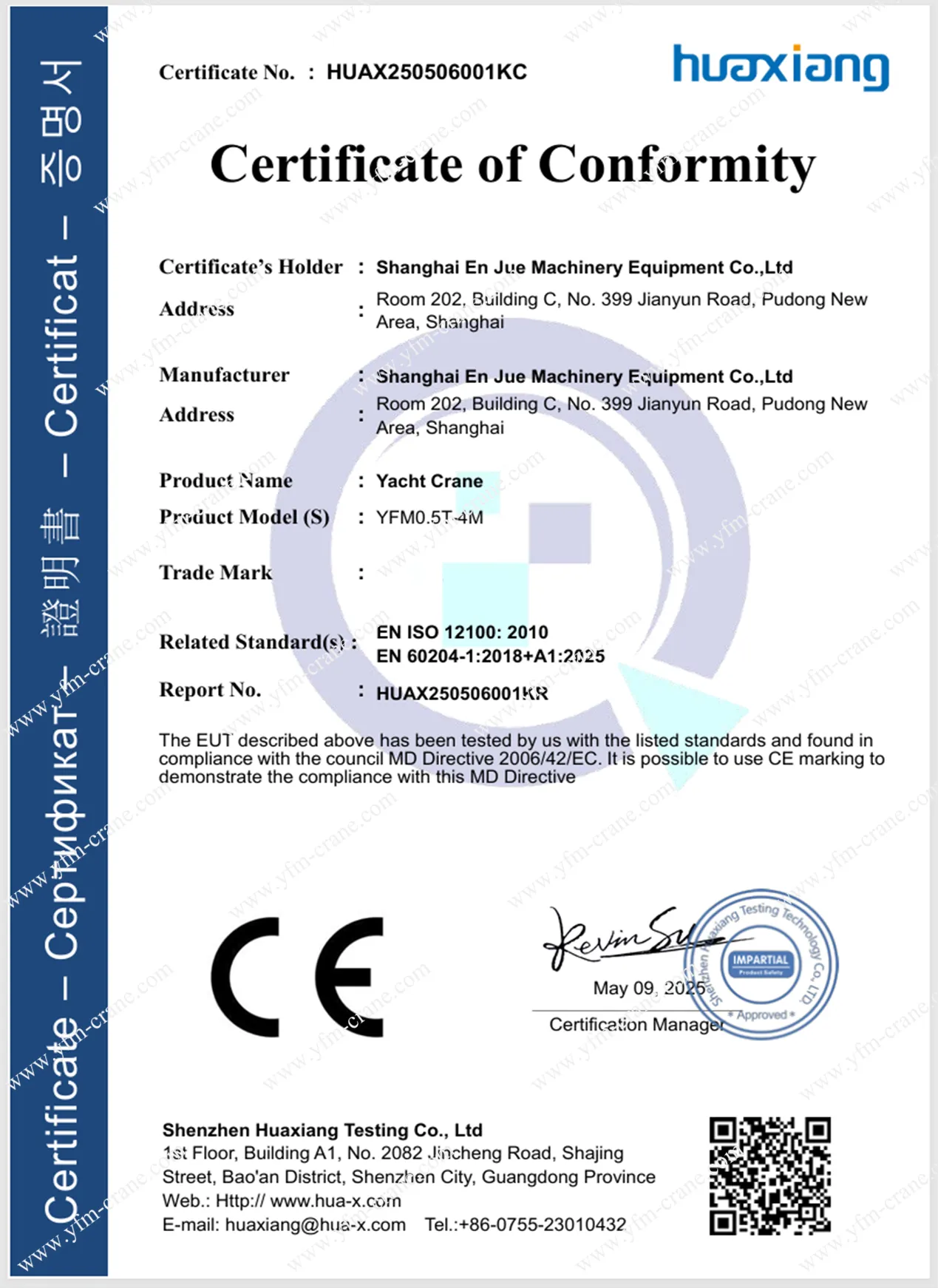
Marine Crane CE Certificate
FAQ
As one of the leading port crane manufacturers and suppliers in China, we warmly welcome you to buy CE Approved port crane for sale here from our factory. All customized products are with high quality and low price.