


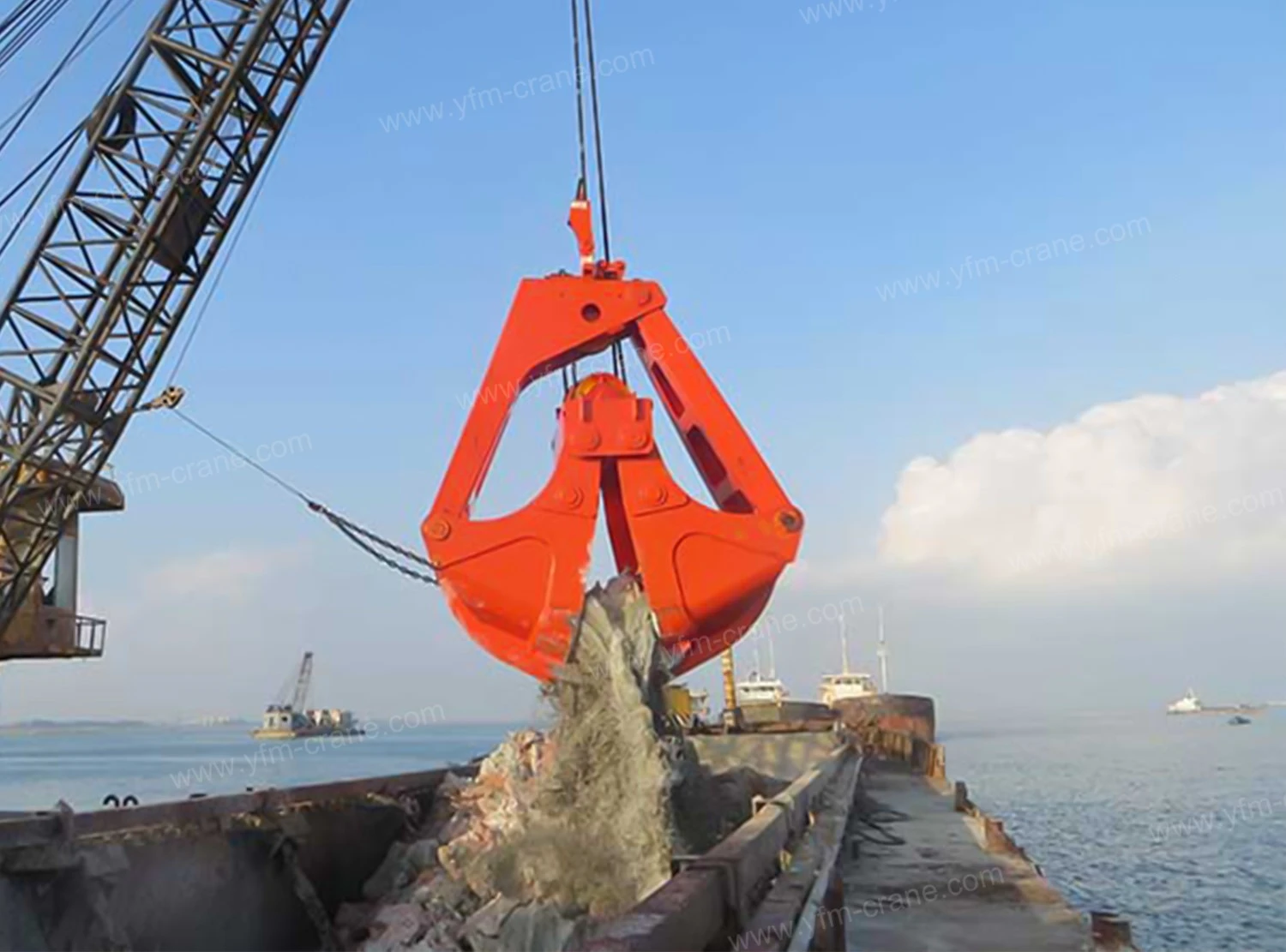
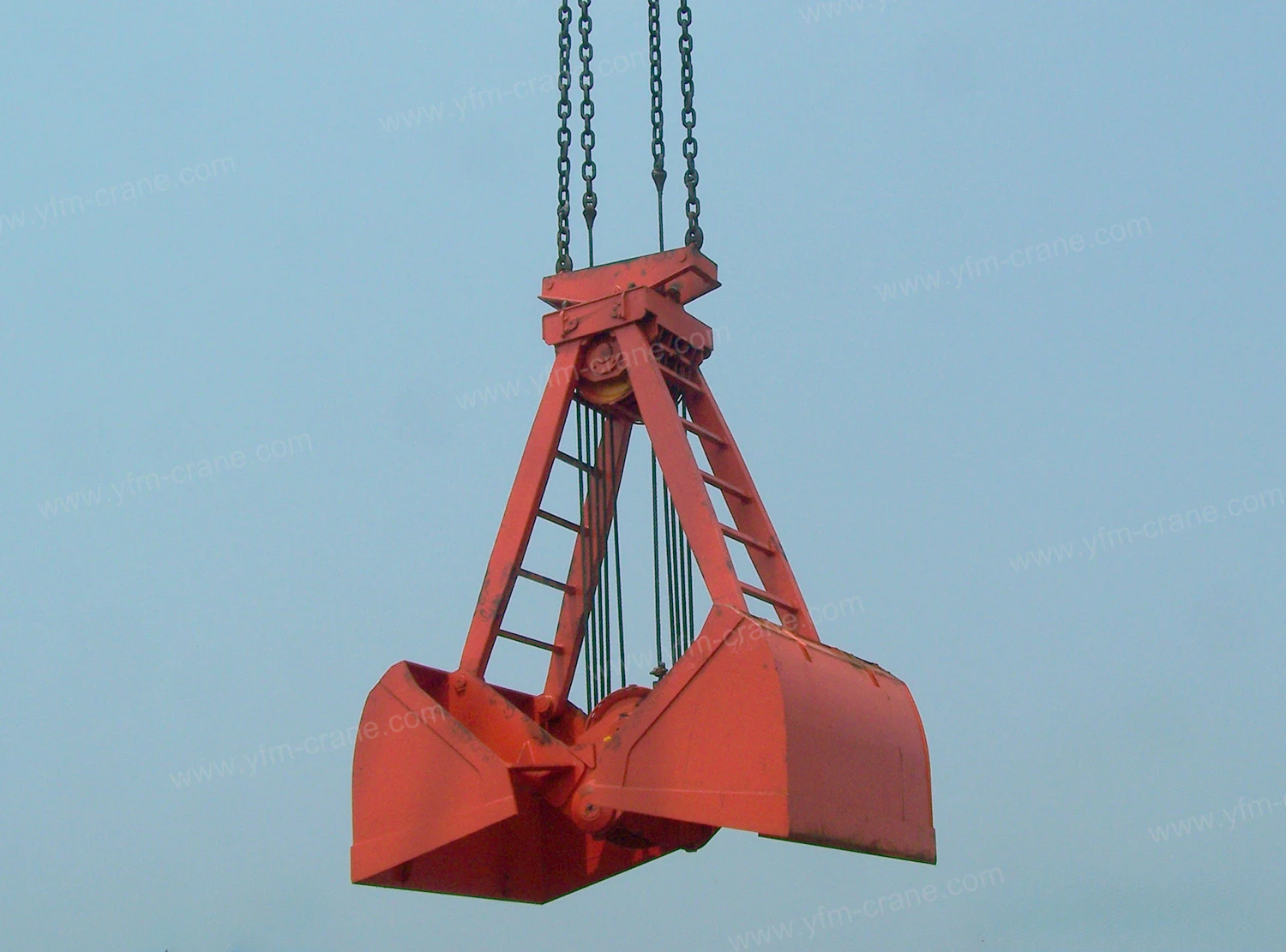

Heavy Duty Grab Bucket for Port& Marine Bulk Handling
Four Rope Mechanical Grab for double drum gantry crane,overhead crane, or deck crane, marine and port ship loading & unloading of bulk...

Mechanical Grab
What Is Mechanical Grab
A mechanical grab bucket is a rope-driven clamshell grab for cranes and unloaders. With no hydraulic cylinders, it relies on a support rope + closing rope and its own dead weight to open and close the shells, making it ideal for continuous unloading of bulk cargo in ports, power plants, and mines.
Main Features
- Single-rope or Double-rope operation (supporting + closing hoist), simple and reliable
- Hydraulic-free, oil-free design – dustproof, saltwater resistant, low maintenance
- Workable underwater and in corrosive environments
- Two-shell (clamshell) for coal, sand, grain, mineral powder, iron ore
- Multi-shell (orange peel) for oversized ore, scrap steel, garbage
-
![Four Rope Mechanical Grab]()
-
![Double Rope Mechanical Grab]() Double Rope Mechanical GrabThe Double Rope Mechanical Grab is designed for double‑drum cranes. It operates with two ropes: one supporting rope and one closing rope, completing grabbing, lifting and discharging in one...read more
Double Rope Mechanical GrabThe Double Rope Mechanical Grab is designed for double‑drum cranes. It operates with two ropes: one supporting rope and one closing rope, completing grabbing, lifting and discharging in one...read more -
![Single Rope Mechanical Grab]() Single Rope Mechanical Grab--- The Simplest Grab You Can Hang On A Crane Hook.read more
Single Rope Mechanical Grab--- The Simplest Grab You Can Hang On A Crane Hook.read more
Single Rope Mechanical Grab: Engineered for single-drum cranes. No hydraulics. No electronics. Just one rope and a mechanical... -
![Scissor Grab For Crane]()
-
![Mechanical Four rope Orange Peel Grab]() Mechanical Four rope Orange Peel GrabThe Mechanical Four rope Orange Peel Grab is an efficient loading and unloading tool for grabbing block, granular or irregular bulk cargo. It controls the opening and closing of the grab through...read more
Mechanical Four rope Orange Peel GrabThe Mechanical Four rope Orange Peel Grab is an efficient loading and unloading tool for grabbing block, granular or irregular bulk cargo. It controls the opening and closing of the grab through...read more -
![Single Rope Touch Open Bulk Grab]() Single Rope Touch Open Bulk GrabThe equipment is highly efficient for loading and unloading bulk materials such as sand, coal, mineral powders, and chemical fertilizers.read more
Single Rope Touch Open Bulk GrabThe equipment is highly efficient for loading and unloading bulk materials such as sand, coal, mineral powders, and chemical fertilizers.read more -
![Four Rope Clamshell Grab]() Four Rope Clamshell GrabThis equipment is specifically engineered for the efficient handling of powder and fine bulk materials.read more
Four Rope Clamshell GrabThis equipment is specifically engineered for the efficient handling of powder and fine bulk materials.read more -
![Dredging Grab]() Dredging GrabThis equipment is primarily designed for dredging sludge, iron plate sand, and stone. Given the high resistance posed by underwater debris, the grab must be constructed from high-quality materials...read more
Dredging GrabThis equipment is primarily designed for dredging sludge, iron plate sand, and stone. Given the high resistance posed by underwater debris, the grab must be constructed from high-quality materials...read more


Materials & Construction
| Part | Material |
|---|---|
| Shells / Bucket Lips |
Hardox 450 / Hardox 500 wear-resistant steel; economic option NM400/NM450/NM500; Q355B for light duty. Cutting-edge reinforced, hard-faced with tungsten carbide for high impact & abrasion |
| Upper/Lower Crossheads & Stay Bars | Q355B (high-strength low-alloy steel), Q690 for heavy-duty large grabs |
| Sheaves | Q355B / cast steel ZG310-570, hardened grooves, optional polyurethane lining to protect the wire rope |
| Pins & Bushings | 40Cr quenched & tempered pins; copper / self-lubricating composite bushings |
| Wire Rope |
6×37, 6×49, 18×7 construction; hot-dip galvanized for marine/corrosive environments |
Advantages of Mechanical Grab
Large opening & bite force
A larger opening and greater bite force when compared to hydraulic grabs which allows for larger and heavier loads to be handled. A higher bite force enables more secure and efficient material handling.
Reinforced plating & hard-faced tips
Hard-facing welds on tips and reinforced plating which increases the lifespan of the grab by providing additional wear resistance and creating additional strength, allowing for increased attachment longevity.
Five-finger interlocked webbed design
Five interlocking fingers provides superior strength and efficiency when grabbing. Securely handle various sized objects, while maintaining maximum opening capacity. This makes our mechanical grab ideal for extensive lifting, carrying or loading operations such as cleaning, log grabbing, demolition work and recycling.
Quick release arm
Mechanism to allow for easy mount/dismount, saving time with attachment changes and improving overall operational efficiency.
Integrated torsional bar
Transfer mechanical load evenly through the torsional bar at the top of both grab arms. This improves lateral strength and handling capabilities which increases the grab’s durability and lifespan.
Why Choose Us
Our factory
Ifima Technology (Shanghai) Co., Ltd.(YFM) was established as an agent subsidiary of Jiangsu YFM group company focuses on expanding oversea market of the crane business. The factory covers an area of 18,000 square meters, with a scientific management team, advanced production equipment, exquisite technology, professional testing and inspecting equipment, as well as completed management system.
Our product
The company's main products are Marine cranes, port cranes, bulk cargo handling grab, and related customized steel structure products.
Our service
There is a skilled sales and R&D team focuses on providing solution-based services pre and after sale to our clients. In order to extend the service life of equipment, Our dedicated team will provide regular maintenance and repair service for your crane , this service is not limited to our products.
Our certificate
As a design and production enterprise of Marine and port equipment , it has been certified by Chinese CCS, American ABS, French BV, Norwegian DNV, British LR, Korean KR, Japanese NK, Russian RS and other classification societies.
Mechanical Grab Details
The mechanical grab itself is not equipped with an open structure, which is usually driven by a rope or a connecting rod. It can be divided into two rope grabs and a single rope grab according to the operating characteristics. The most common is a double rope grab.
The double rope grab has support rope and open and closed rope, which is wound around the supporting mechanism and the opening and closing mechanism. It is the working process of double rope grab: a is the support rope and the open and closed rope falling simultaneously, and the opening bucket is inserted into the pile. It is to tighten open the closed rope, the jaw plate closes and grabs the material. It is the support rope and the open and closed rope rising at the same time. Support the rope, open and close the rope to descend, the hopper open and unload the material. Double rope grab work is reliable, easy to operate, high productivity and wide application. After two sets of double rope, it becomes a four-rope grab, and the working process is the same as the double rope grab.
Single rope grab support rope and open and closed rope with the same steel wire rope. The wire rope is supported and closed by means of special locking device. The winding mechanism of single rope grab is relatively simple, but the productivity is low.
The gripper can be divided into light (such as grasping grain), medium (such as scraping gravel) and heavy (such as grasping iron ore)3 classes according to the accumulation density of captured materials. The jaw plate is divided into two jaw plate grab and multi jaw plate grab, the most commonly used is the double jaw plate grab. For large blocks of ore, iron scrap and scrap steel, it is suitable to use the multi-jaw plate grab, because it has the characteristics of multi-claw and notch tip, easy to insert the material pile, and can get better grasping effect. There is also a shear grab that imitates the structural principle of scissors. Its grasping force increases with the closure of the jaw plate and reaches the maximum at the closing time. The bucket mouth opening and the area of the cover material is better than general grab for the big, to improve the ability to capture, is good for cleaning the yard and the cabin, but for the big materials because of its initial grasping force is small, the effect is poorer.

How to Operate a Mechanical Grab
Fit the rubber pads arms to the foot of the grab (if not already fitted) and attach with two safety lynch pins per pad arm. Insert the lifting pin from the Self Locating Yoke (separate attachment) or the swivel hook (separate attachment) through the lifting eye of the Scissor grab. With the unit in the locked open position proceed towards your intend pack (if the unit is not in the open position fully close the grab and lift again).
Adjust the actuator wheels (Model ISG-5 only) so that when the white nylon wheels make contact with the top of the pack the rubber pads arms are positioned within the bottom half of the bottom row of blocks (the actuator wheels are positioned by retracting the sprung loaded pin from the positioning hole then slide the actuator wheel assembly to its new desired position ensuring that both sides are in the same corresponding holes).
Lift the grab so that it is positioned directly above the intend pack and lower the grab until the actuator wheels are resting on the pack (do not slam the grab down on the pack) and the grab has fully closed. Once closed begin to lift, the rubber pad arms will then begin to close on to the bottom block of the pack, continue to lift until the grab has lifted the pack clear of the ground/pallet.
Once the pack is clear slide a restraint net (optional extra) under the pack and hook the net into the four profiled restraint net hooks in the main frame (this must be adhered to if lifting overhead). Drive the forklift to the desire position and then lower the grab until the pack comes into contact with a firm surface and actuator wheels once again resting on the pack (remove the net prior to this if fitted). The rubber pads arms will now have released from the bottom block, but then continue to lower until the grab has fully closed. Lift the grab clear of the pack and the unit will now be in its fully locked open position ready for the next operation.
How Does A Mechanical Grab Work?
Approach and positioning
The crane with the mechanical grab attachment is maneuvered into position above the material to be lifted. The crane operator ensures that the mechanical grab is properly aligned and positioned for effective engagement with the load.
Activation and grip
Once the mechanical grab is positioned correctly, the operator activates the mechanical grab's mechanism. The activation method depends on the mechanical grab type and may involve hydraulic, mechanical, or electrical controls. The activation causes the mechanical grab's jaws or shells to close around the material.
Grip adjustment
After the initial grip, the operator may need to adjust the grip to ensure a secure hold on the material. This adjustment allows for proper balance and stability during the lifting process. Depending on the mechanical grab type, there may be mechanisms or controls that enable the operator to fine-tune the grip.
Lifting
With the material securely held in the mechanical grab, the crane operator activates the lifting mechanism of the crane. This mechanism may involve a hoist or winch system, which raises the load off the ground. The crane's lifting capacity and the mechanical grab's design determine the maximum weight the mechanical grab can handle.
Transport and release
Once the material is lifted, the crane, with the attached mechanical grab, can transport the load to the desired location. The mechanical grab's design and features, such as trolley or crab mechanisms, allow for lateral movement along the crane's bridge. When the load reaches the intended destination, the operator activates the mechanical grab's release mechanism to open the jaws or shells, thereby releasing the material.
Maintenance of Mechanical Grab
The scissor grab should be inspected weekly for general condition with particular attention paid to: A – all weld points, b – wear & distortion of lifting eyes and rubber pad arms, c – any damaged components, d – locks & latches, e – security of all nuts and bolts, f – security and condition of rubber pads. General surface rusting especially in critical areas should be treated with proprietary inhibitors, primers and paint on a regular basis. All hinges, latches, locks, hinge points and springs must be kept lightly greased. Damage or failure must be reported or rectified immediately prior to re-use of the grab. This product is certified for six (6) months from the date of manufacture after which it is the customer’s responsibility to have the product re-tested at an approved testing facility or inspected and logged in a register by a competent person.
The manager of the department or section where the attachment is to be used must be responsible for ensuring the operators are fully conversant with the attachment, its operation and maintenance. Never lift an unstable pack of blocks.
Ensure all packs are banded together. Never stand between or under the grab under any circumstances. Always use a restraint net when lifting overhead.
Ensure that the grab is lifting on the centre of gravity of its intended load. Never grab beyond halfway up on a block on the bottom row of a pack. Keep hands and fingers clear of all moving parts so as to prevent trapping. Never shock load the grab when loaded as this may result in losing the load. Always ensure that the grab is fully closed between each operation so as to ensure that the release mechanism correctly rotates.

What Is the Difference Between Mechanical Grab and Hydraulic Grab?
Mechanical grabs, also known as mechanical grapples, operate through direct physical force. These robust attachments consist of hinged arms or jaws that close around the material. Mechanical grabs rely on mechanical linkages, pulleys, and levers. They do not require hydraulic power or electrical connections. Operators control the grab’s movement manually. Mechanical grabs excel in scenarios where hydraulic systems are unavailable or impractical. Common applications include waste handling, scrap yards, and small-scale material sorting. Simplicity: Mechanical grabs have fewer components, making them straightforward to operate and maintain. Cost-Effective: They do not rely on hydraulic systems, reducing operational costs.
Hydraulic grabs, also called hydraulic grapples, utilize hydraulic power to operate. Hydraulic grabs connect to hydraulic circuits on machinery (such as excavators, cranes, or loaders). Operators control the grab’s opening, closing, and rotation using hydraulic controls.
Hydraulic power provides precise and efficient movement. Hydraulic grabs are widely used in construction, forestry, demolition, and material handling. They handle diverse materials, including logs, rocks, scrap metal, and waste. Precision: Hydraulic grabs allow fine-tuned control, crucial for delicate operations. Versatility: They adapt to various tasks, from heavy lifting to precise sorting. Safety: Operators can maintain a safe distance from hazardous materials.
Hydraulic power is unavailable or impractical. Simplicity and cost-effectiveness are priorities. You need a basic grab for light-duty applications. Precision and versatility matter. You operate hydraulic machinery (excavators, loaders, etc.). Safety and efficient material handling are critical. Both mechanical and hydraulic grabs have their place in material handling. Assess your specific requirements, consider the available equipment, and make an informed choice. Whether you opt for the rugged simplicity of mechanical grabs or the precision of hydraulic grabs, remember that the right grab enhances productivity and ensures smooth operations.
Our factory
Ifima Technology (Shanghai) Co., Ltd.(YFM) was established as an agent subsidiary of Jiangsu YFM group company focuses on expanding oversea market of the crane business. There is a skilled sales and R&D team focuses on providing solution-based services pre and after sale to our clients, The company's main products are Marine cranes, port cranes, bulk cargo handling grab, and related customized steel structure products. The factory covers an area of 18,000 square meters, with a scientific management team, advanced production equipment, exquisite technology, professional testing and inspecting equipment, as well as completed management system. As a design and production enterprise of Marine and port equipment , it has been certified by Chinese CCS, American ABS, French BV, Norwegian DNV, British LR, Korean KR, Japanese NK, Russian RS and other classification societies. "Quality first, Good faith, Be Customer-centric" as the corporate culture, YFM is committed to provide oversea customers with high-quality product and perfect services.


FAQ
As one of the leading mechanical grab manufacturers and suppliers in China, we warmly welcome you to buy CE Approved mechanical grab for sale here from our factory. All customized products are with high quality and low price.
mechanical grab, Single Rope Touch Open Bulk Grab, Four Rope Clamshell Grab