


Hydraulic Rotating Container Spreader is a lifting beam designed for loading and unloading 20ft, 40ft and 45ft ISO standard containers. When matched with a rotary hook, it enables 360° rotation. This spreader is specially engineered to pair with overhead cranes, floating cranes and portal cranes. Driven by a hydraulic system, it features high automation and superior working efficiency, with the capability to rotate containers independently. It is ideal for ports and terminals requiring container rotation and high handling speed. Its rated lifting capacity is 45 tons, and custom design is available to meet practical project requirements.
The core functionality of this hydraulic rotating container spreader relies on the hydraulic drive system. The hydraulic system generates mechanical power through fluid pressure, delivering power and positioning accuracy required for heavy container lifting. Consisting of pumps, actuators, valves and other components, the full hydraulic system jointly controls the movement of the crane boom and slewing (rotating) mechanism.
Main structure
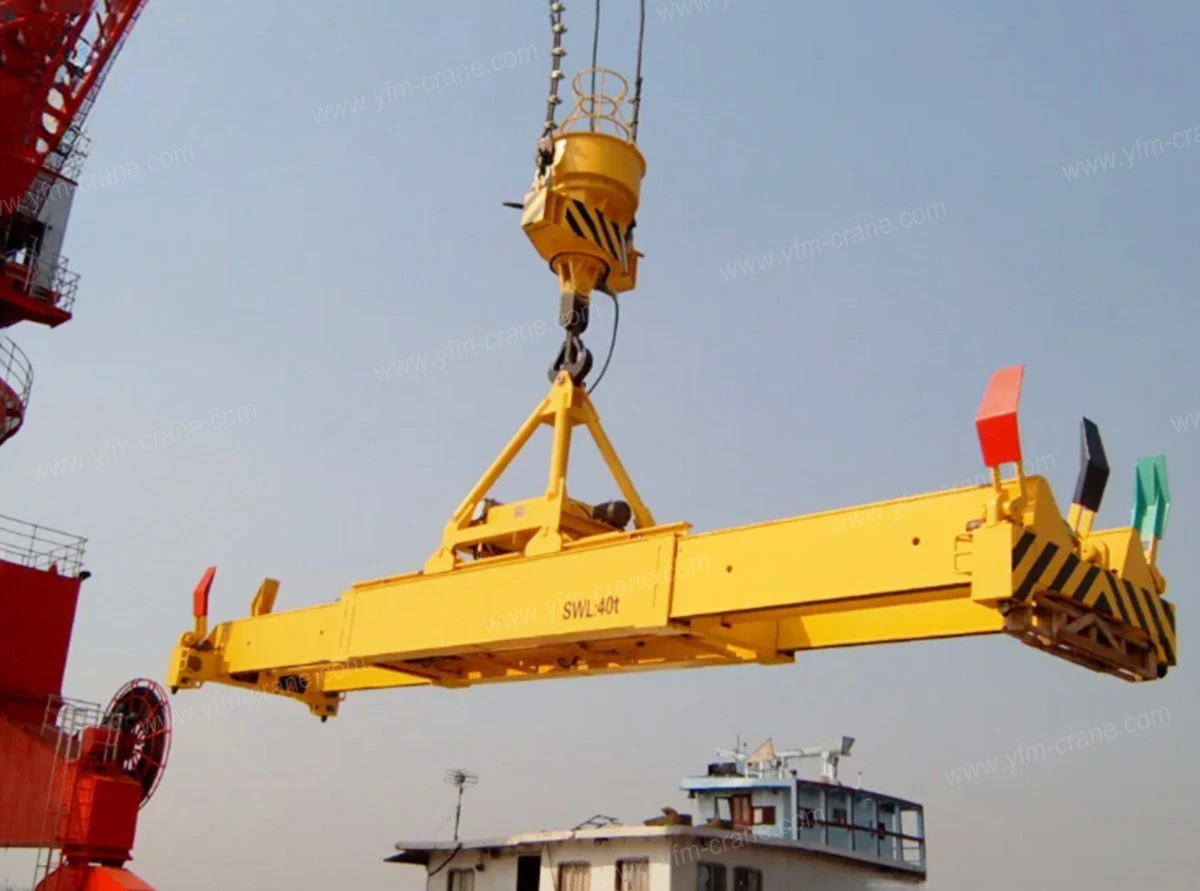
1. Main Frame
The main frame of the hydraulic rotating container spreader is usually made of high-strength steel, which has good rigidity and stability. Inside the mainframe are the hydraulic system, electrical system, and other key components.
2. Telescopic Beam
A hydraulic system drives the telescopic beam and can be freely retracted within the main frame to accommodate different sizes of containers (such as 20 feet and 40 feet.). A hydraulic motor and a chain drive complete the telescopic action.
3. Rotating Mechanism
The rotating mechanism employs a slewing bearing structure. It is driven by a hydraulic motor, and the rotation of the spreader is achieved through a reducer and a meshing gear. The rotation speed is typically 1 rpm, and the maximum rotation angle can reach up to 360°.
4. Rotary Lock Device
The turn-lock device is utilized for connecting and unlocking with the container corner piece. It is actuated by a hydraulic cylinder, enabling quick locking and releasing. The action of the rotary lock is highly responsive and is usually completed within 1 second.
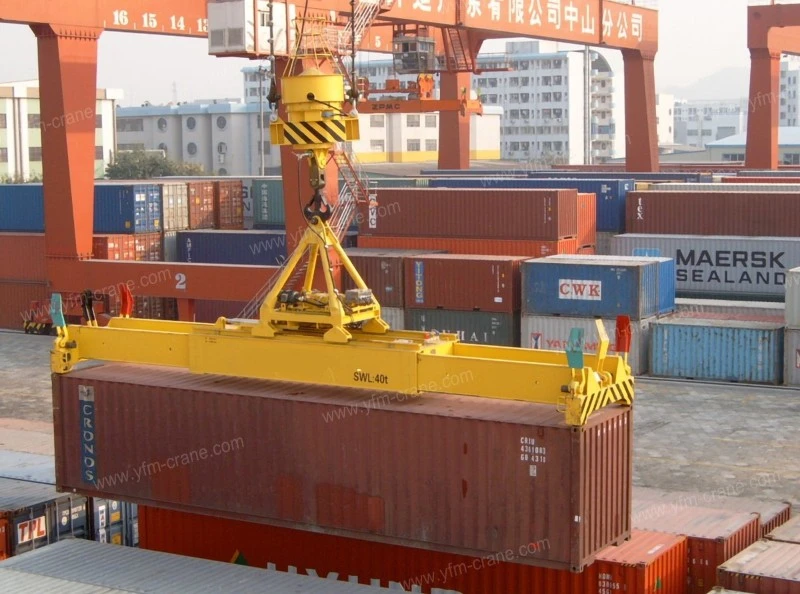

5. Guide Plate Device
The guide plate device is used to assist in aligning and positioning the container and is usually driven by a hydraulic cylinder that allows for a 180° swing. The flare design of the guide unit facilitates automatic alignment of the container.
6. Hydraulics System
The hydraulic system serves as the core power source of the spreader. To ensure the stability and durability of the system, high-quality hydraulic components (such as hydraulic pumps, hydraulic cylinders, hydraulic valves, etc.) are employed.
7. Electrical System
The electrical system consists of a control panel, various sensors, and a PLC control system. These components work together to enable the automatic operation and provide safety protection for the spreader.
Core Advantages
The core advantages of Hydraulic Rotating Container Spreader
01
Efficient operation capability
02
Precise positioning operation
03
Wide applicability
04
Improve space utilization
05
Reduced reliance on manpower
06
Enhanced safety
product data
| Type | SWL | Dead Weight | Source | Suitable Container |
| 20/40feet Hydraulic Rotating Container Spreader | 45T | 8.8T | 440V/3P/50HZ | 20/40/45ft |
Comparison
| Comparison Items | Telescopic and Rotating Container Spreaders | Fixed Container Spreaders | Telescopic Container Spreaders |
|---|---|---|---|
| Structural Features | Complex mechanical structure, including telescopic arms, rotating mechanisms, and hydraulic and electrical control systems; the telescopic arms can flexibly adjust their length, and the rotating mechanism enables the spreader to rotate around the vertical axis. | Simple structure, composed of basic components such as frames and lifting claws; the shape and size are fixed, without telescopic or rotating functions. | Equipped with a telescopic function, adapting to containers of different sizes through the telescopic frame; usually without a rotating function. |
| Functional Advantages | Possess the operational capability in three-dimensional space, being able to telescope to adapt to the length changes of container types and rotate to adjust the lifting angle of containers. They can accurately position containers under various complex working conditions, improving lifting efficiency and accuracy. | Relatively single-function, only capable of performing basic lifting and lowering actions, suitable for occasions where the container type is fixed and the lifting requirements are not high. | The mechanism is highly adaptable and capable of handling containers of different sizes by adjusting its length through the telescopic mechanism. While it may have limited angle adjustment ability, it can still cater to a variety of containers. For precise container alignment, it's advisable to use additional auxiliary operations. |
| Application Scenarios | Modern port terminals, large logistics warehouses; environments featuring frequent multimodal transport, container transshipment, and having high requirements for operation efficiency and precision, such as the container lifting in large automated port terminals. | Small ports, specialized terminals, or specific industrial sites, where the container sizes are uniform, the operation processes are relatively fixed, and there is a low requirement for the flexibility of the spreader. | For most conventional container lifting operations, the mechanism is suitable for use in various ports and logistics centers. It has good adaptability to the mixed operations of containers of different sizes. However, in scenarios with strict requirements for the container placement angle, it's crucial to work in tandem with other equipment to ensure precise operations. |
| Cost and Maintenance | High manufacturing cost and relatively expensive purchase price; high requirements for maintenance, requiring professional technicians to regularly inspect, maintain, and service the telescopic and rotating mechanisms as well as the hydraulic and electrical systems, resulting in high maintenance costs. | It has a simple structure, low manufacturing and purchase costs, and is relatively easy to maintain, requiring only routine inspections and maintenance with minimal expenses. | The cost and maintenance lie between those of the above two types; the telescopic mechanism is relatively complex and requires regular inspection and maintenance. Without a rotating mechanism, the maintenance workload and cost are relatively lower than those of telescopic and rotating container spreaders. |
Why choose YFM?
Here Are Four Reasons Why You Choose Us
Our company is committed to the research and development, design, production, manufacturing, sales, and service of port terminals, marine vessels, construction machinery, non-standard machinery, and other equipment. We provide a one-stop solution. We pay attention to every detail of the product and craft it carefully. We firmly believe that the achievement of customers is the achievement of ourselves.
If you have any needs for custom-made non-standard port machinery, I can provide you with consultation and services.
Email: megy@yfm-crane.com
Tel/WhatsApp:+86-17612748600
01
One-stop solution
We provide a full range of products in the field of ports, terminals, and ocean vessels, providing a one-stop solution.
02
Professionally customized
We provide professional customized services according to customer needs.
03
Perfect service
We provide a full range of services before, during, and after sales.
04
High quality
We implement strict quality control throughout production to guarantee reliable equipment performance.
Hot Tags: Hydraulic Rotating Container Spreader, China Hydraulic Rotating Container Spreader manufacturers, suppliers, factory, Over Height Container Lifting Frame, lifting spreader, over height spreader beam, Frame Type Container Spreader, container adapter, lifting bar