


The boom structure design is the core determinant of the performance of offshore cranes. Its selection directly affects the lifting capacity, operational flexibility, energy efficiency, and environmental adaptability. The following systematically analyzes the impact of straight boom, telescopic boom, telescopic folding boom, folding boom, and truss boom on performance from the perspective of structural type.
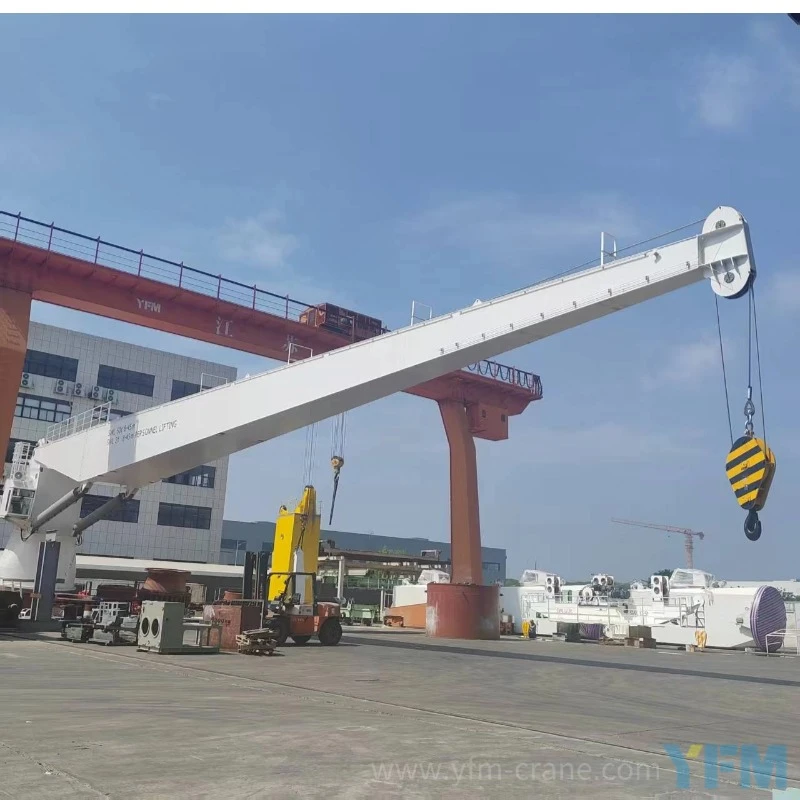
- Design principle of straight boom: single-section or multi-section fixed boom, vertical take-off and landing are achieved through a wire rope drum, with simple structure and high rigidity.
Performance:
- Lifting capacity: suitable for medium and short distance lifting, the maximum lifting weight of offshore models can reach 500 tons, but the working radius is limited (usually ≤30 meters).
- Stability: through rigid connection and hull structure to coordinate force, strong wind and wave resistance, but slow dynamic response.
- Economy: low manufacturing cost (20%-30% lower than telescopic arm), easy maintenance, suitable for standardized operation scenarios.
- Application scenarios: offshore supply ships, port container lifting.
2. Telescopic boom offshore crane
- Telescopic boom design principle: Multi-section boom nested telescoping structure, driven by a hydraulic cylinder to achieve stepless length adjustment.
Performance:
- Operating range: The working radius can reach more than 150 meters, suitable for deep-sea platform equipment installation (such as high-altitude docking of wind power towers).
- Dynamic response: Using a servo-hydraulic system, the boom extension speed reaches 0.5 m/s, and the positioning accuracy error is ≤±3 cm. Energy efficiency: The hydraulic drive system has high energy consumption (30% higher than the electric system), but energy consumption can be reduced by 15% through energy recovery technology (such as potential energy conversion into electrical energy).
- Application scenario: Deep-sea wind power installation ship.
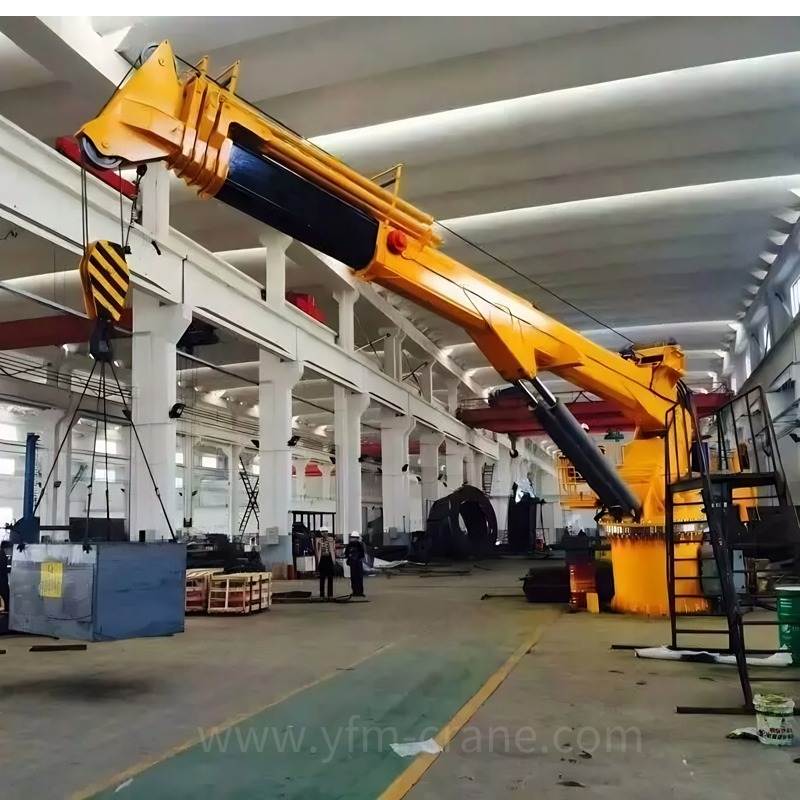
- Design principle of the folding boom: A four-link mechanism is used to achieve multi-angle folding of the boom, combining the advantages of straight booms and telescopic booms.
Performance:
- Flexibility: ±120° pitch angle adjustment can be achieved to adapt to complex space layouts (such as operations around narrow decks or obstacles).
- Dynamic compensation: An active wave compensation system is required to control the load swing amplitude within ±5% under level 6 sea conditions.
- Structural complexity: The multi-joint design leads to an increase in deadweight (15%-20% heavier than the straight boom), and the material strength needs to be optimized to improve the load-bearing capacity.
- Application scenarios: offshore rescue ships, submarine cable laying.
4. Telescopic folding deck crane
- Design principle of telescopic folding arm: Combining the composite structure of the telescopic arm and folding arm, the arm length adjustment and multi-angle folding are achieved through hydraulic drive.
Performance:
- Spatial adaptability: It can flexibly bypass obstacles on narrow decks or dense ship areas (such as inland ports), and the operating radius covers a wider range.
- Operation efficiency: It adopts multi-cylinder collaborative control, and the action response speed is 20% higher than that of traditional folding arms, supporting fast and accurate positioning.
- Energy consumption characteristics: The all-electric drive system is combined with active heave compensation technology, which reduces energy consumption by 25% compared with pure hydraulic systems, and can integrate battery packs to achieve energy optimization.
- Application scenario: Offshore platform equipment maintenance.


- Truss arm design principle: It is composed of a triangular truss structure, which achieves high rigidity and light weight through axial force on the rods.
Performance:
- Load-bearing capacity: High-strength seamless steel pipes and straight seam welded pipes are used.
- Wind resistance: The truss structure has a low wind resistance coefficient (40% lower than the box-type structure), and can withstand a level 12 typhoon after finite element optimization.
- Material innovation: The carbon fiber composite truss arm is 49.5% lighter than steel and has a 49% lower deflection, but the cost is higher (the initial cost is 3-5 times that of steel).
- Application scenarios: Overall lifting of ultra-large offshore platforms and handling of heavy equipment in ports.

One-stop offshore crane Factory in China
When searching for a reliable ship crane, you need to consider the structure and design of the marine crane boom. YFM-designed offshore cranes are patented and certified by major classification societies. They provide excellent performance and stability. Our experienced team can assist in designing the right boom for your needs. Contact us today to learn more about our hydraulic crane boom selection!