


Summary
As a special type of lifting equipment, a pontoon floating crane has attracted much attention for its flexibility and versatility on the water surface. In this paper, the working principle, structural characteristics, application areas, and future development trends of pontoon floating cranes will be discussed in depth. Through a comprehensive analysis of the pontoon floating crane, it aims to provide a reference for researchers and engineers in related fields.
Introduction
With the rapid development of ocean engineering, port construction, and other fields, the demand for water operation is growing. Traditional land cranes are subject to many restrictions when operating on water, while pontoon floating cranes have gradually become the preferred equipment for water operation with their unique advantages. The pontoon floating crane cannot only move freely on the water, and has a large operating range and high efficiency.
The working principle of a pontoon floating crane
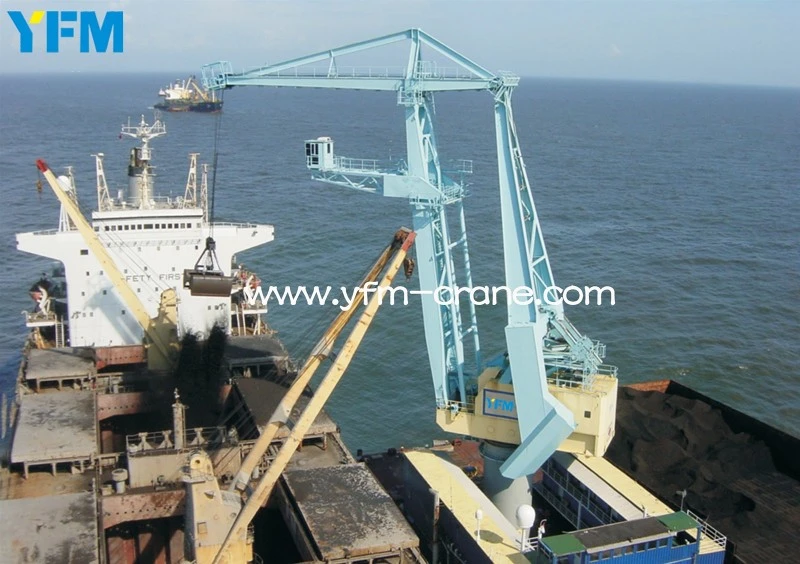
The working principle of the pontoon floating crane is relatively simple. It is mainly composed of three parts: pontoon, crane, and propulsion system. The pontoon provides enough buoyancy so that the whole equipment can float on the water's surface; the crane is responsible for completing the lifting operation, can be lifted from the water, can also be lifted from the ship or shore to the ship; the propulsion system enables the floating crane to move on the water surface, to reach the operating position.
A Pontoon Floating Crane is a kind of special equipment with both buoyancy and lifting capacity, and its structural characteristics are mainly reflected in the high strength of the pontoon, its multi-compartment design, and the diversity of the crane. It plays an important role in the fields of port operation, marine engineering, hydropower engineering, ship construction, and emergency rescue. With the development of science and technology, the pontoon floating crane is constantly developing in the direction of intelligence, modularity, and environmental protection to meet increasingly complex operational needs.
Specifically, the pontoon floating crane usually consists of high-strength steel or concrete pontoons, a variety of types of cranes, and propulsion systems. Ballast water tanks are set inside the pontoon to ensure the stability of the equipment. Its wide range of applications, not only can be used for port cargo handling but also involved in the installation and maintenance of offshore platforms, underwater equipment operations, the construction of large ships and sea rescue, and so on. In the future, the pontoon floating crane will be through the introduction of artificial intelligence technology to achieve automation, modular design to improve flexibility, and the use of environmentally friendly materials and energy, to better serve human society.
Conclusion
As an efficient and flexible water operation equipment, floating cranes play an increasingly important role in modern engineering construction. With the continuous progress of science and technology, the application of pontoon floating crane will be more and more broad.
👉+86 15818704927
👉anne@yfm-crane.com/info@yfm-crane.com