


YFM Crane is capable of providing customized lifting solutions for different types of commercial marine vessels. So, how does YFM offer customized services for ship cranes used in various commercial marine scenarios? When providing customized services for various ship scenarios, selecting cranes for ships with the appropriate functions is a crucial step, which requires comprehensive consideration of factors such as ship type, operational requirements, and environmental conditions. Starting from common ship scenarios, the following explains how to achieve customized services by selecting ship cranes with different functions:
I. Container Ship Scenario
Core Requirement: Efficient loading and unloading of standard containers (20-foot, 40-foot, 45-foot, etc.), which need to match the size and stacking requirements of the containers.
Adaptable Ship Crane Functions:
- Container-Specific Spreader(Container Spreader): The spreader can quickly lock/unlock container corner fittings to achieve "one-click grabbing". The telescopic range of the boom should cover the different stacking heights on the ship's deck (usually 8-10 layers of containers).
- Telescopic Spreader: Some models can be equipped with a telescopic spreader to lift 2 x 20-foot containers simultaneously, improving loading and unloading efficiency (capable of handling 30-40 standard containers per hour).
- Anti-Sway Control System: Reduces the sway of the spreader caused by sea winds or ship motion, preventing container collisions and enhancing operational safety.
Customization Focus: Adjust the boom span according to the ship's deck width and hatch size, and design the spreader's lifting stroke in combination with port tide changes.

II. Bulk Carrier Scenario (Transporting Coal, Ore, Grain, etc.)
Core Requirement: Continuous and large-capacity loading and unloading of bulk cargo, the cargo bulk carrier crane needs to adapt to differences in cargo density and avoid dust emission or scattering.
Adaptable Crane Functions:
- Replaceable Grab-Type Spreader: Select special grabs for different cargos - heavy-duty wear-resistant grabs (mechanical grab, made of high-strength steel) for ore, closed grabs (clamshell grab, to prevent scattering) for grain, and semi-open grabs (balancing efficiency and dust prevention) for coal.
- Large Lifting Capacity + High Working Class: The ship crane's lifting capacity is usually 25-100 tons, and the working class reaches A6-A8 (suitable for continuous high-intensity operations), ensuring that the daily loading and unloading volume meets the ship's turnover requirements (e.g., 10,000-20,000 tons/day).
- Dust-Proof and Environmental Protection Design: Sealing rubber strips are added at the closing of the grab, and a spray dust suppression device is installed at the root of the boom to meet port environmental protection requirements.
Customization Focus: Adjust the grab volume according to the cargo specific gravity, and design the boom length in combination with the depth of the ship's cargo hold to avoid operational blind spots.

III. Oil Tanker / LPG Carrier Scenario
Core Requirement: Lifting oil pipes, valves, and other equipment (not directly loading and unloading cargo), the ship crane needs to adapt to flammable and explosive environments and ensure operational safety.
Adaptable Crane Functions:
- Explosion-Proof Design: The deck crane's key components, such as motors and control systems, adopt explosion-proof grades (e.g., Ex dⅡCT4) to avoid dangers caused by electric sparks; metal structural parts are equipped with anti-static grounding devices.
- Precision Control System: The marine crane should be equipped with frequency conversion speed regulation and micro-motion control functions to ensure the stable movement of the spreader when approaching the hull, avoiding leaks caused by collisions.
- Corrosion-Resistant Materials: Exposed parts such as the boom and base are treated with stainless steel or anti-corrosion coatings to resist corrosion from seawater and oil, and gas.
Customization Focus: Design a foldable boom according to the space constraints of the ship's deck (foldable boom crane, to reduce space occupation when idle), and select manual/automatic operation mode based on the operation frequency.
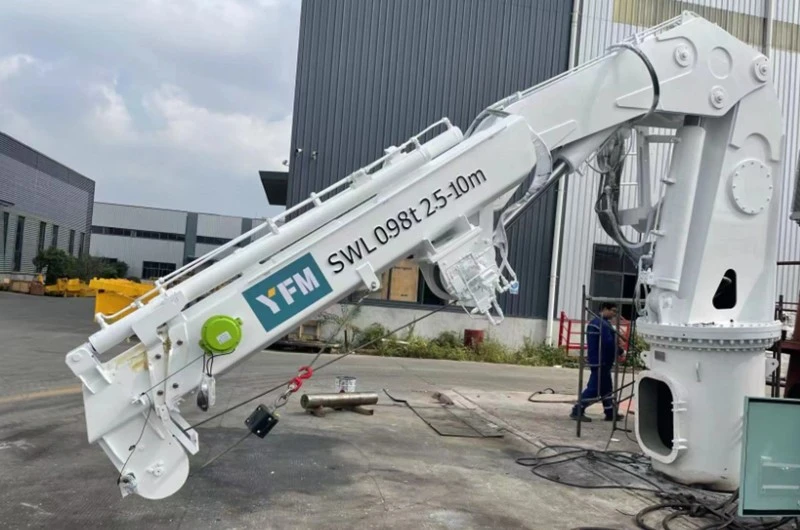
IV. Engineering Vessel / Salvage Vessel Scenario
Core Requirement: Lifting large engineering equipment (such as drilling platform components, sunken ship wreckage), the ship crane needs to adapt to complex sea conditions and have strong stability.
Adaptable Crane Functions:
- Full-Slewing Structure: The deck crane can rotate 360°, combined with a luffing mechanism to achieve a wide range of operations, adapting to the multi-directional lifting needs of engineering vessels.
- Super Lifting Capacity + Auxiliary Hook Design: The crane's main hook can lift hundreds of tons (e.g., 300-500 tons), and the auxiliary hook is used for lifting light auxiliary equipment, improving operational flexibility.
- Marine Working Condition Enhancement: The base is equipped with stable outriggers or counterweight systems to reduce the impact of ship shaking on lifting accuracy. High-toughness steel is used to resist wave impact.
Customization Focus: Design the anti-overturning coefficient according to the wind and wave level in the operating sea area, and adjust the lifting rope length in combination with the salvage depth (usually more than 100 meters).
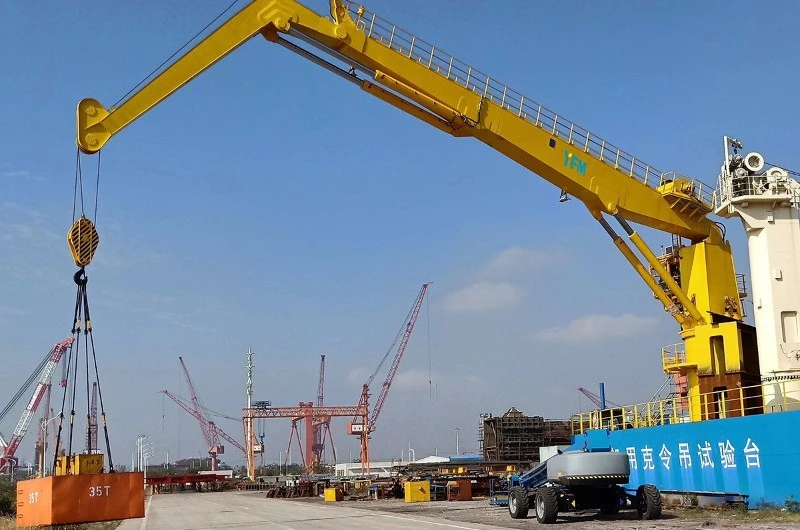
V. Ro-Ro Ship Scenario (Transporting Vehicles, Construction Machinery, etc.)
Core Requirement: Lifting overweight vehicles or large construction machinery (such as trucks, excavators), the marine crane requires balancing load-bearing capacity and operational convenience.
Adaptable Crane Functions:
- Wide Boom + Heavy-Duty Hook: The crane's boom span should cover the width of the Ro-Ro ship's ramp (usually 6-10 meters), and the hook adopts a double-hook or balance beam design to avoid cargo tilting.
- Quick Luffing Function: The crane's boom can quickly adjust the angle (0-80°), shortening the transfer time of vehicles from the dock to the cabin.
- Anti-Skid and Buffering Devices: Anti-skid pads are added at the hook, and a buffering system is activated during lifting/lowering to prevent vehicles from sliding due to inertia.
Customization Focus: Determine the lifting capacity according to the maximum weight of the transported vehicles (e.g., 30-80 tons), and adjust the minimum working height of the marine crane's boom in combination with the height of the ship's cabin door.
By matching the core needs of different ship scenarios with the ship crane's spreader type, lifting capacity, structural design, safety functions, etc., precise customized services can be achieved, ensuring that the equipment efficiently adapts to the operational scenarios while reducing operational risks.

Call to Action (CTA):
Need a Customized Marine Crane?
📞+86 15818704927
✉️ anne@yfm-crane.com/info@yfm-crane.com
🌐 https://www.yfm-crane.com/contact-us